
International.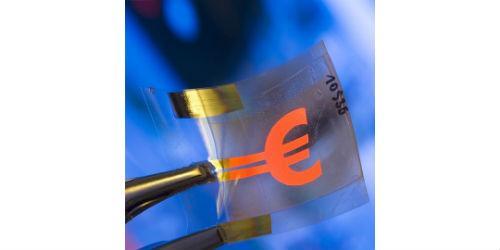 When ultra-thin transparent varnishes are applied on the transparent sheet tapes, defects in the coating can now be made visible and immediately during the coating process. This is possible thanks to an in-line detection system that uses fluorescent dyes.
The method has been developed by three institutes of the Fraunhofer Polymer Surface Alliance (Polo). High-tech applications, such as ultra-barrier films for OLEDs, benefit from online process control preventing production errors and unnecessary complaints. The dye/chamber system can also test the authenticity of fluorescence-labeled materials. The system is presented at the K 2016 plastics fair.
The ultra-barrier film, developed by Polo, must meet the highest standards for the encapsulation of light-emitting organic diodes or solar cells. It protects sensitive organic materials from oxygen and water vapor for years.
The film has to be thin and transparent. An important layer for barrier properties - an extremely thin varnish - consists of a hybrid polymer (Ormocer) developed by the Fraunhofer ISC. The varnish layer has to be precisely the same thickness everywhere and be less than one micron. The Fraunhofer Institutes for Applied Polymer Research (IAP) in Potsdam, by IVV Process Engineering and Packaging in Freising, and for ISC Silicate Research in Würzburg have developed an in-line detection system that makes
this possible.
- Determining the thickness distribution and curing degree in real time
- Reducing costs thanks to perfect layers
- Chemically non-analyzable: materials with marked fluorescence.
Source: Fraunhofer.