
United States.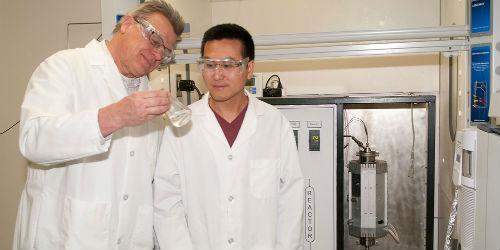 A research team at Washington State University (WSU) has used a simple and common industrial process in a new way to create chemicals widely used as fuel additives and as raw materials for plasticizers, detergents, lubricants and cosmetics.
Using the Fischer-Tropsch process to make alcohols and aldehydes in large quantities could reduce the cost and energy needed to produce the chemicals and possibly provide cleaner manufacturing.
A patent has been filed in the process by Norbert Kruse, WSU Voiland Distinguished Professor, and Yizhi Xiang, a postdoctoral fellow at Gene and Linda Voiland School of Chemical Engineering and Bioengineering.
The Fischer-Tropsch process is a chemical reaction that uses catalysts to convert two gases, carbon monoxide and hydrogen, into liquid fuels in a simple, one-step process. It has been used for nearly a century to create liquid fuels, which are made of long chains of molecules containing only carbon and hydrogen.
Current industrial processes for alcohols and aldehydes require starting with a complex petrochemical-based target molecule, an olefin, which is then converted to liquid chemicals in a complicated multi-step series.
To make the alcohols and aldehydes in the fischer-Tropsch process in a single step, the WSU researchers use a catalyst made of cobalt, manganese and potassium. To form the liquid, the two gases react on the surface of the solid catalyst.
"Catalyst preparation is very important," Kruse said. "And the chemical aspect is wonderful: From just two effect gases, we find a technically useful liquid that is usually only obtained after a number of steps in petrochemical refining. I think there is a good opportunity for industrial application."
Both cobalt and manganese are available in abundance, and the whole process could be significantly less expensive than more complicated methods.
Source: Washington State University.