
United States.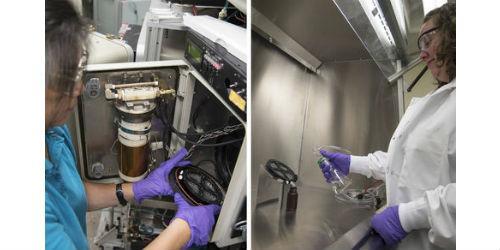 Researchers at the National Institute of Standards and Technology (NIST) have described how they subjected a commercial nanoparticle-infused coating to methods developed by NIST to accelerate the effects of weathering from ultraviolet (UV) radiation and simulated rainwater washes.
Their results indicate that humidity and exposure time are contributing factors to the release of nanoparticles, findings that may be useful in the design of future studies to determine potential impacts.
In their experiment, the researchers exposed several samples of a commercially available polyurethane coating containing silicon dioxide nanoparticles to intense UV radiation for 100 days inside the NIST sphere (simulated photodegradation through high-energy radiant exposure), a hollow, of a black aluminum chamber lined with a diameter of 2 meters (7-feet) with highly reflective UV material.
For this study, one day in the sphere was equivalent to 10 to 15 days outdoors. All samples were degraded to a constant temperature of 50 degrees Celsius (122 degrees Fahrenheit) with one group made in extremely dry conditions (about 0 percent humidity) and the other in humid conditions (75 percent humidity).
Source: National Institute of Standards and Technology.