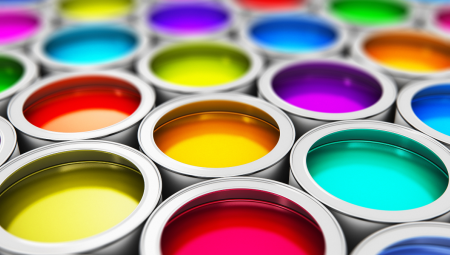

International.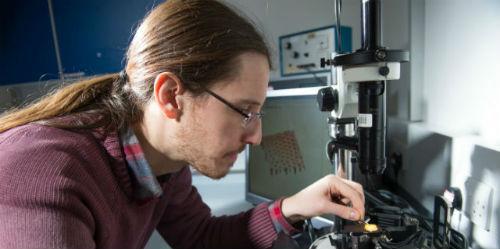 Researchers at the University of Surrey, in collaboration with Claude Bernard University, Lyon (France) used computational simulation and experiments on materials to show how when coatings with different particle sizes, such as dry paints, the coating spontaneously forms two layers.
This mechanism can be used to control properties at the top and bottom of coatings independently, which could help increase coating performance across industries as diverse as beauty and pharmaceuticals.
"When coatings such as paint, ink or even outer layers are made on tablets, they work by diffusing a liquid containing solid particles onto a surface, and allowing the liquid to evaporate. This is nothing new, but what is interesting is that we have shown that during evaporation, small particles push away the larger ones, remaining on the upper surface while the larger one is pushed down. This happens naturally," said Dr Andrea Fortini, from the University of Surrey and lead author of the research.
The author further said that "this kind of 'self-layering' in a coating could be very useful. For example, in a sunscreen, most sunlight-blocking particles could be designed to be pushed toward the top, leaving particles that can stick to the skin near the bottom of the coating. Typically, the particles used in coatings have sizes that are 1,000 times smaller than the thickness of a human hair, so the engineering of these coatings is carried out at a microscopic level."
Image: University of Surrey.