
United States.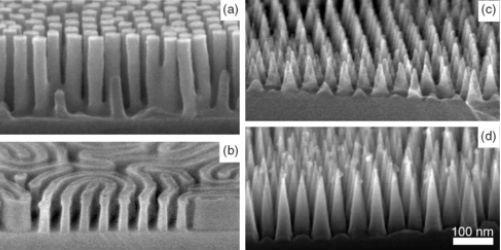 Conventional superhydrophobic coatings that repel liquids by trapping air inside microscopic pockets on the surface tend to lose their properties when liquids are forced into those bags.
In this work, conducted by scientists at the U.S. Department of Energy, extreme water repellents or superhydrophobic surfaces were manufactured that can withstand pressures 10 times greater than the average pressure a surface would experience at rest in a room. The surfaces resist the infiltration of liquid into the nanoscale bags.
The degree to which the nanometer-sized textured supuerhydrophobic coating can withstand high pressures is largely determined by the geometry of the texturing. This work demonstrates that through a careful fine-tuning of the nanoscale geometry, a substantial improvement in the durability and applicability of these structures can be made for solar panels, of great robustness, self-healing coatings and anti-icing applications.
Superhydrophobic coatings repel liquids by trapping air within microscopic surface textures. However, the resulting composite interface is prone to collapse under external pressure. Nano-sized textures should facilitate more resistant coatings due to nanoscale geometry and confinement effects.
Source: U.S. Department of Energy.