
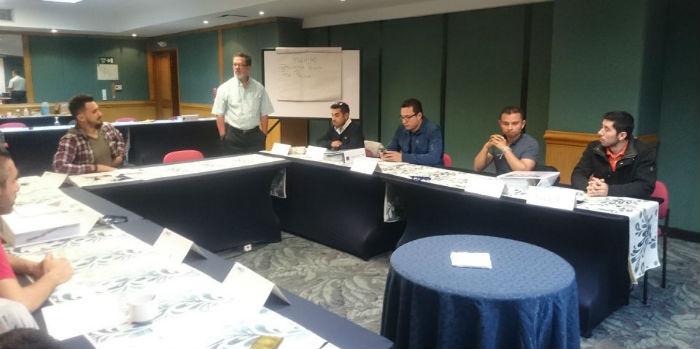
 Colombia. NACE International and ACICOR Colombia confirmed their calendar of courses and events to be held throughout 2019.
Bogotá will host all the courses, except one that will be held in the city of Barranquilla and another in Cartagena. Below we present the programming of the year:
BC- Corrosion Engineering
This course focuses on corrosion and potential problems caused by corrosion. It provides a basic but comprehensive review of the causes of corrosion and the methods by which they can be identified, monitored and controlled.
Bogotá, February 18 - 22.
CIP Level 1
This course provides the technical and practical foundations for coating inspection work on structural steel projects.
Barranquilla, April, 1 - 6.
CIP Level 2
This course focuses on advanced inspection techniques and specialized applications for steel substrates and other substrates other than steel. The course covers extensively what is related to surface preparation, types of coatings, inspection criteria and types of failures for different coatings.
Bogotá, July 8 - 13.
CP1
This course includes topics in basic electricity, electrochemistry and corrosion concepts, cathodic protection theory (CP), CP systems, and CP field measurement techniques. This course provides theoretical knowledge and practical foundations for inspection and testing of galvanic and printed current CP systems.
Bogotá, July 8 - 12.
CP2
Topics in this course include intermediate-level discussions on corrosion theory and the concepts of cathodic protection (CP), types of CP systems, eddy current interference AC and DC, and advanced field measurement techniques.
Bogotá, July 15 - 19.
Internal Corrosion for Pipelines - Basic
This course provides the fundamentals of implementing, monitoring, and maintaining a comprehensive corrosion control program as part of a comprehensive Pipeline Integrity Management program. This course focuses on the internal corrosion of natural gas and hydrocarbon transportation and distribution lines.
Bogotá, August 5 - 9.
In Line Inspection (ILI)
The course covers the benefits and limitations of online inspection; the selection of technologies related to operating parameters, and operational aspects; its relationship to an overall integrity assessment programme; and industry standards, norms and best practices.
Bogotá, August 12 - 16.
Internal Corrosion for Pipelines -Advanced
This course focuses on the monitoring techniques and mitigation strategies required to assess internal corrosion and develop and administer an internal corrosion control program. This course covers in detail the interpretation, analysis and integration of data; as well as the criteria for determining corrective actions for high-level internal corrosion problems in piping systems.
Bogotá, September 2 - 6.
Direct Assessment (DA)
This course focuses on internal, external corrosion and the direct evaluation of stress corrosion cracking along with pre and post evaluation, quality control, data analysis and integration and remediation and mitigation activities. The course also covers the benefits and limitations of Direct Assessment, its relationship to an overall integrity assessment programme and industry standards, regulations and best practices.
Bogotá, September 2 - 6.
Pipeline Corrosion Integrity Management
(PCIM)
This course provides the key elements for implementing and managing an integrity program for pipeline corrosion-related threats.
Bogotá, September 9 - 13.
Offshore Corrosion Assessment Training (O-CAT)
This course addresses the elements of in-service inspection and maintenance planning for fixed offshore structures. Also covered in this course are the Mineral Management Services (MMS) A-B-C Facility Assessment Classification System requirements for Level 1 inspection reports.
Bogotá, September 16 - 20.
Marine Coating Technology
The course covers the fundamental aspects that are specific to coatings in the marine industry. After a description of the most common types of ships, the course describes the types of corrosion that affect the areas of ships, the types of coatings and coatings that are effective in the marine environment, the shipbuilding process, surface preparation, The PSPC IMO for ballast tanks, cargo tanks and voids, as well as in-service study and inspection, inspection records and procedures. This course was prepared by a team of experts with more than 20 years of experience in the marine coatings industry developed with both shipowners and shipyards.
Bogotá, September 23 - 26.
Marine Forum
Cartagena, September 27
CP3
This course covers both the theoretical concepts and the practical application of cathodic protection with a strong focus on data interpretation, repair, and mitigation of problems that may occur for both galvanizing and printed current systems.
Bogotá, October 7 – 12.
More information in the email [email protected]