
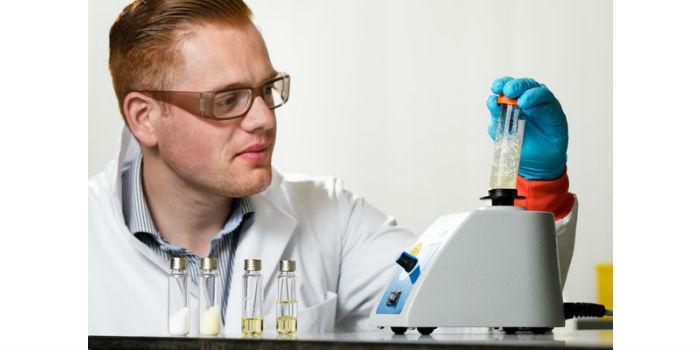
 International. Many polluting solvents used by the chemical industry can be replaced by a surprising new mixture of two powders: "deep eutectic solvents" (DES). This next generation of solvents is sustainable, much less flammable, non-volatile and can extract contaminants from water beyond the capabilities of current solvents, according to the Eindhoven University of Technology.
The current generation of solvents has several disadvantages. Alcohol, for example, is volatile and flammable. Acetone, benzene, hexane and toluene are highly toxic, harmful to the environment and unhealthy.
Deep Eutectic Solvent
When two powders are mixed, they sometimes form a liquid with properties that current solvents lack. Such a liquid is called a deep eutectic solvent or DES. Powders can be extracted from plants.
The solvent developed by Van Osch is:
- Environmentally friendly
- Hydrophobic
- Free of fire risk
- It is not harmful to health.
A DES can dissolve substances with which current solvents have great difficulty.
Sustainable ingredients
Plants can be considerably more sustainable than petroleum products and therefore DES is a sustainable replacement for many solvents. Many plant extracts are non-toxic, which eliminates the health risk. The same applies to the volatility and flammability of plant-based components.
This makes DES an attractive substitute for alcohol and acetone, for example. There are many options when choosing the ingredients of a DES. Examples of DES ingredients are menthol and thymol, extracted from the mint plant and the thyme plant respectively.
Water-soluble DES are not new: scientific literature dating back to 1918 describes that a mixture of two powders can sometimes form a liquid. Nonetheless, it took until 2015 before TU/e researchers Dannie van Osch and colleagues developed a hydrophobic DES. The importance of a water-repellent solvent is significant because it is able to remove contaminants from the water.
Extractions of this type are often performed, but they are difficult and harmful to the environment.
Van Osch showed that with a water-repellent DES it is possible to remove metal ions (heavy), fatty acids and vitamin B2 from water
Multiple applications
Future research will focus on determining des phase diagrams made of various ingredients: in what proportion the powder mixture becomes liquid and what are its solubility-related qualities.
In addition, the solubility of CO2 in these sustainable solvents has been studied. A potential application for this is CO2 capture. In addition, the production costs of DES must be reduced before the chemical industry can fully cover DES.
The thesis written by Dannie van Osch is entitled "Design and Applications of Deep Eutectic Hydronic Solvents" and will be defended in public on September 18 at the Eindhoven University of Technology.
Data Source Provider: Eindhoven University of Technology.