
Corrosion is one of the biggest challenges industries face by compromising the safety and durability of their assets. This article addresses the importance of proactive corrosion protection, highlighting the role of coatings and maintenance engineering in extending the life of equipment and structures.
By Eng. Abel de la Cruz*
Corrosion control plays a critical role in extending the life of industrial assets, as corrosion is one of the main factors that can compromise the structural and functional integrity of equipment and structures leading to significant costs and impacts on the environment, safety, life and health. Extending the life of an asset not only means maximizing its effective and safe uptime, but also minimizing the costs associated with premature replacement or extensive repairs due to corrosion.
From a technological perspective, corrosion control involves the implementation of preventive measures and management strategies that help prevent, detect, and mitigate the effects of corrosion throughout the asset's lifecycle. This may include the proper selection of corrosion-resistant materials during the design phase, the design of cathodic or anodic protection systems, the design, selection, specification, and application of protective coatings, the implementation of corrosion protection preventive maintenance and monitoring programs, the use of corrosion inhibitors, etc.
From a financial perspective, corrosion control can result in significant savings over time by avoiding costly unplanned shutdowns, emergency repairs, or even premature replacement of equipment and structures due to catastrophic failures caused by corrosion. In addition, extending the useful life of assets can increase their net economic value by enabling greater revenue generation over a longer period, as well as reducing the capital costs associated with acquiring new assets.
It is clear that corrosion is a constant concern with which we need to know how to live in the different aspects of our lives. In this article, we will particularly explore the importance that should be given to Corrosion Protection Maintenance Engineering and the essential use of corrosion prevention coatings to extend the life of industrial assets.
We must underline that practice in this field highlights the critical need to address corrosion from a proactive perspective, which is completely contrary to current practice, where maintenance plans go after corrosion to correct deterioration reactively.

Corrosion Protection Maintenance Engineering
It focuses on the implementation of preventive strategies to control and mitigate corrosive effects. The use of coatings emerges as an essential tool within this discipline, acting as a protective barrier between the metal and the corrosive environment or environment.
Corrosion protection maintenance engineering or anti-corrosion maintenance engineering is an approach aimed at preserving the integrity of industrial assets, it is based on the strategy of assessing and reducing the overall risk of catastrophic failures of operating facilities, it is the key tool to establish a critical maintenance path, with the aim of concentrating a greater maintenance effort (hierarchizing) in high and medium risk areas, whereas, in low-risk areas, effort is minimized to decrease the total scope of work and the cost of the maintenance program in a structured and justifiable manner. Effective maintenance requires fewer interventions throughout the asset lifecycle, reducing downtime and improving operational efficiency.
For the above, it is incredible and inadmissible that for many years the Corrosion Protection Maintenance or Anticorrosive Maintenance with coatings has been enclosed in the concept of "Paint or Repaint" a surface, whose state of the old or aged paint has a certain degree or percentage of failures or deterioration and/or through the visible presence of rust stains on the surface with old paint, as some self-styled "experts" still suggest.
Why is corrosion protection maintenance engineering?
Corrosion protection maintenance is engineering for several fundamental reasons related to the application of engineering principles and methods in the management and preservation of physical assets. Here are some of the key reasons:
Resource optimization: Anti-corrosion maintenance engineering seeks to optimize the performance and reliability of assets, minimizing costs and maximizing efficiency. A systematic approach is applied to ensure that resources, whether human, material, technological or financial, are used efficiently.
Methodologies and tools: Anti-corrosion maintenance engineering uses engineering methodologies and tools, such as risk analysis, system modeling, and reliability techniques. These tools help to understand and address the specific challenges associated with asset maintenance.
Preventive and predictive approach:
Through anti-corrosion maintenance engineering, it seeks to implement preventive and predictive strategies. This involves proactively identifying potential failures and applying corrective actions before significant problems occur, which is a typically engineering approach.
Lifecycle Management:
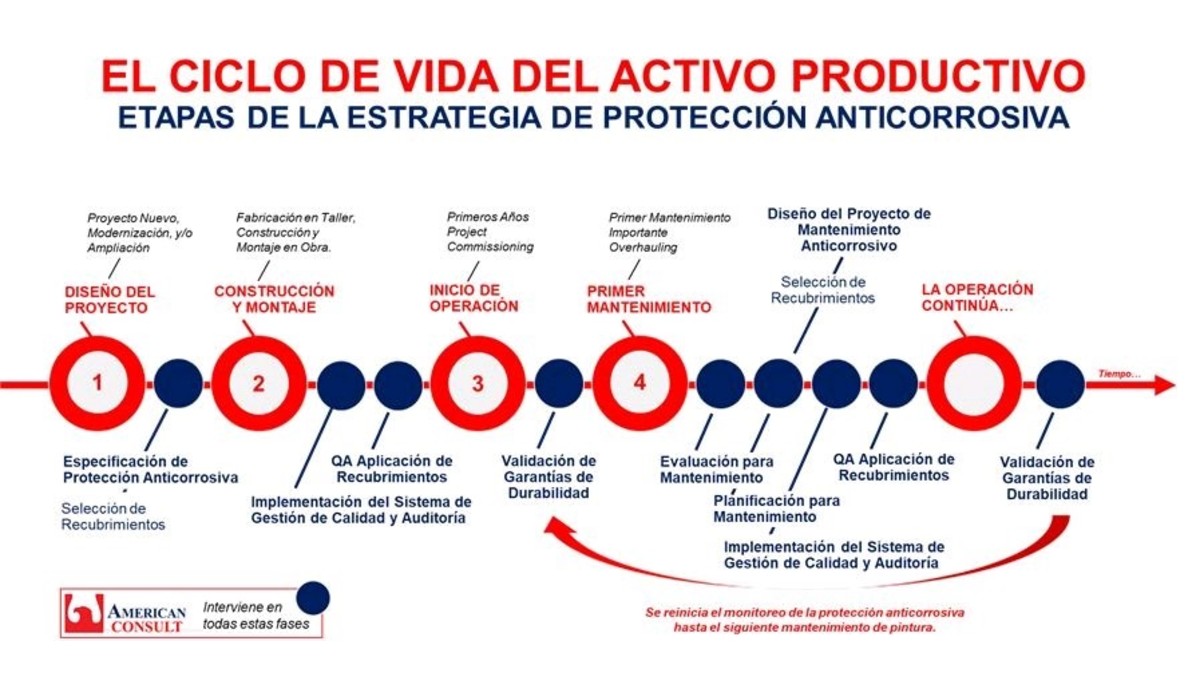
Anti-corrosion maintenance engineering addresses the entire lifecycle of assets, from planning and design to decommissioning.
It focuses on maximizing the life and performance of assets, considering technical, economic, and environmental aspects.
Technological innovation:
Anti-corrosion maintenance engineering is constantly evolving, leveraging technological innovations to improve practices and processes. The application of technologies such as real-time monitoring, data-driven maintenance, and artificial intelligence demonstrates the engineering nature of this discipline.
Continuous monitoring and evaluation: Implementing an anti-corrosion maintenance plan doesn't end with coating application. A continuous monitoring program is established, which includes regular technical inspections to evaluate the effectiveness of coatings. Adjust the plan according to changing conditions and the evolution of the operating environment.
In short:
Maintenance engineering uses engineering principles, methods, and tools to ensure the optimal availability, reliability, and performance of physical assets throughout their lifecycle. The systematic application of technical and scientific approaches to address maintenance challenges clearly places it within the realm of engineering.
Overall, effective corrosion control is essential to ensure the integrity, reliability and profitability of industrial assets throughout their useful life, which requires a combination of technological and financial approaches to prevent, detect and mitigate the adverse effects of corrosion in a cost-effective and sustainable manner.
"Corrosion protection is not just a technical necessity, but a smart business decision that safeguards investment and ensures a path to sustainable success."
*Consultant in Corrosion and Integrity Management
Instructor in Coatings Technology
INFOCORROSION.COM TRAINING CENTER
Titular Manager of AMERICAN CONSULT
Phones +51-1-3443174, Mobile- Whatsapp: +51-996885664,
E-Mail: [email protected]
[email protected]