
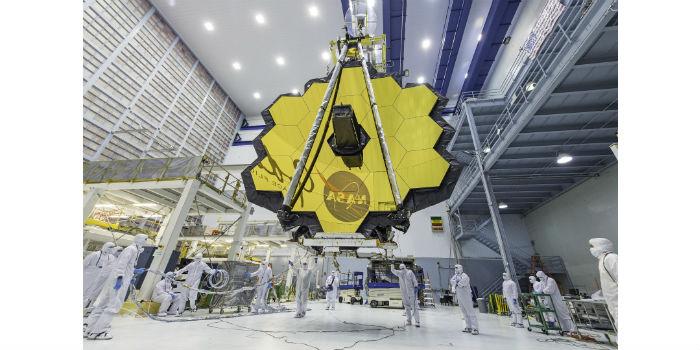
 United States. NASA revealed that the coating that was used to cover the Oscars is the same that is implemented for telescopes that allow us to see distant galaxies: gold.
Gold is useful in space, because it's good at reflecting infrared wavelengths of light, which help detect celestial objects from far away. Even better, says Goddard Space Flight Center physicist Jim Tuttle, "Gold is really inert. It does not rust at all. "That means it won't fog up."
Because of both properties, gold is also a good way to block the absorption of radiant heat. That's why the James Webb Space Telescope team chose gold to coat a 32-foot coolant tube that cools the Mid-Infrared Instrument, or MIRI.
The most common method for coating gold is by steam deposit: the metal is heated in a vacuum until it becomes a gas, which then condenses into a thin layer across a surface.
The process is effective but has drawbacks. On the one hand, gold loses some of its reflectivity. Beyond that, gold becomes extremely delicate.
"We've seen many times over the years, that someone will put a nice layer of gold on top of something, but as soon as they fold it, all of a sudden, a whole layer of gold will peel off and peel off," says Goddard engineer John Gygax. Not only does reflectivity decrease, but flakes can interfere with sensitive instruments.
Good enough for Mars
The telescope's designers wanted a gold-plating method that would maintain the high reflectivity of solid gold and be extremely durable. For that, they turned to Brooklyn-based Epner Technology, which has been working with NASA since the 1970s and perfected its electroplating technique by doing aerospace work in the 1990s.
Epner's technology claimed his gold would never fall, but, Gygax says, "we hesitate. That's why we made them try it for us, and they did it."
The company also boasted that its gold plating was significantly more reflective than the gold deposited in steam. Again, Goddard's team wanted to be safe, so this time they turned to Tuttle, a cryogenics researcher who designed an experiment that showed that reflectance would be sufficient at their extremely low operating temperatures aboard Webb.
Epner uses an electrodeposition process he calls LaserGold. The resulting coating was already harder and more reflective than the gold deposited in the vapor phase, but both attributes have been further enhanced through the company's work at NASA. A key improvement came when NASA told Epner it needed better reflectivity in a golden mirror for the Mars Orbiter laser altimeter, without losing strength.
Around the same time, the team that built the Keck Observatory telescopes needed additional hardness to ensure their secondary gold-plated infrared mirror could be cleaned without scratches. (Keck was not a NASA mission, though the space agency later joined as a partner.)
In order to meet the needs of both aerospace projects, Epner modified its patented processes to ensure the highest possible reflectivity while achieving a hardness triple that of pure gold. The trick, Epner explains, was to modify the electric current to get a more compact atom. Because gold remains pure, reflectivity remains extremely high.
And the Oscar is for . . .
Since then, Epner has used the improved technique for its varied commercial customers, from Braun ear thermometers to infrared carbon dioxide detectors and gold-plated lace jewelry.
In 2016, Epner's reputation for durable, shiny gold coatings, built in part during his many years working for NASA, brought a new client: the Academy of Motion Picture Arts and Sciences. The Academy was impressed that Epner Technology was giving them a galjanoplasty technique that had been used for gold in space for 30 or 35 years, recalls company president David Epner.
For more than three decades, a trophy maker had been placing the Oscars in a tin alloy and then plated them in gold. They were shining, but the cloak faded.
"We guarantee that our gold layer will never come out," says Epner. In fact, Epner has offered a lifetime warranty to rethink, for free, any Oscar that starts to show wear and tear. "It's something I'll never have to fulfill," he says.
NASA has a long history of technology transfer to the private sector. Each year, the agency's Spinoff publication describes about 50 NASA technologies that have been transformed into commercial products and services, demonstrating the broader benefits of U.S. investment in its space program. Spinoff is a publication of the Technology Transfer Program at NASA's Space Technology Mission Directorate.
Source: NASA.