
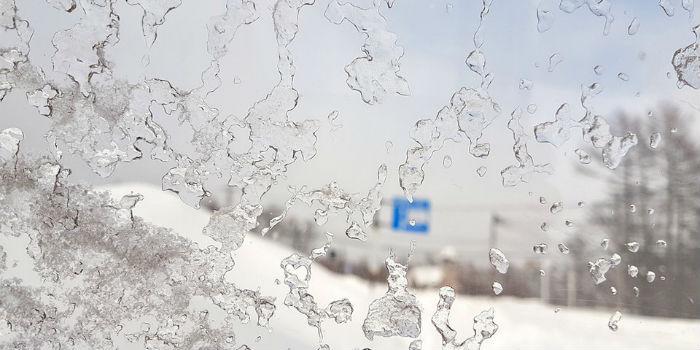
 United States/China. Water-repellent surfaces and coatings could make ice removal a literal breeze by forcing ice to grow rather than skating, according to a new study from the University of Nebraska-Lincoln and several Chinese institutions.
The research findings suggest that applying water-repellent coatings to windshields before winter storms, or engineering surfaces that inherently repel water, could allow a strong breeze to handle the burden of ice removal.
Experiments and simulations showed that a drop of water on a repellent surface will freeze upward in a microscopic six-armed formation that resembles an idealized snowflake, with only a small portion of its base adhered to the surface. This makes sense given that water droplets accumulate rather than spread over repellent surfaces, said Nebraska co-author Xiao Cheng Zeng.
Temperature and pressure mostly dictate how outdoor water droplets crystallize, and those variables have a factor in ice formation on solid surfaces, Zeng said. But the team's study suggests that a surface's contact angle, the angle formed by a droplet of water and a solid surface, determines whether ice will grow along or off the surface.
While a hydrophilic surface allows water to spread through it with a small contact angle, a hydrophobic surface that repels water will force droplets to form a large angle.
"Whether water freezes in one way or another depends on the surface, not the temperature," Zeng said. "It's almost completely dependent on the angle of contact."
On a defect-free surface manufactured in the lab or modeled in a computer simulation, ice transitions from along the surface to the outside grow at a contact angle of between 30 and 40 degrees, the team found.
The researchers also found that increasing the roughness of a surface by widening its nanoscopic pores actually lowered this angular threshold, meaning that rougher surfaces don't need to be so water-repellent as to encourage ice growth that is more easily removed.
Data Source Provider: University of Nebraska.