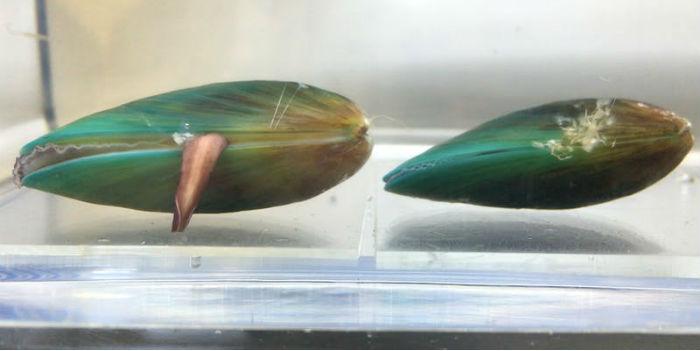
 International. Researchers at Wyss (Harvard) and collaborators at NTU Singapore have developed a non-toxic coating, infused with lubricant that prevents mussels from sticking.
Wyss' SLIPS technology, inspired by the slippery lip of a pitcher carnivorous plant that sends insects sliding toward their destination, takes advantage of the fact that it is very difficult for an organism to adhere to a liquid surface. SLIPS consists of a solid surface infused with a liquid layer of lubricant that is held in place, so that anything that comes into contact with the liquid layer simply slides directly.
SLIPS have previously been shown to be effective against bacteria and algae, but mussels represent a particularly intimidating enemy. Your muscle feet produce adhesive filaments called hinge threads whose tips, called adhesive plates, contain special adhesive proteins that remove water molecules from the target surface to allow the plates to attach to it.
To investigate whether SLIPS could be held against these biofouler experts, the NTU team led by Miserez placed Asian green mussels on panels with a checkerboard pattern of different types of non-biocidal anti-fouling surfaces underwater and left it to the mussels to choose where to fix.
Two different types of slippery surfaces infused with silicone oil as a lubricant were evaluated:
- A very thin 2D coating, based on silica and nanostructured applied layer by layer (i-LBL)
- A thicker, matrix-like 3D coating made of the common polymer polydimethylsiloxane (i-PDMS)
Included for comparison were infused versions of these coatings, a tungsten oxide-based 2D coating, uncoated glass and two commercially available non-biocidal impurity release coatings (Intersleek 700 and Intersleek 900). After 24 hours, Intersleek 700 had ~75 mussel adhesive plates per panel while i-PDMS had only five mussel plates in one out of a total of fifteen panels, indicating that the mussels did not stick well to i-PDMS.
NTU researchers continued their research to determine exactly why mussels didn't easily bind to i-PDMS. The team measured the force needed to extract the mussel threads from the various surfaces and found that the threads attached to the Intersleek coatings required two to six times the force needed to remove the i-PDMS threads and the threads attached to the non-infused coatings needed ten times more force.
Source: https://wyss.harvard.edu