
 International. Reductions of 20 percent in paint use, 15 percent in energy consumption and 5 percent in production time – the SelfPaint automated paint system offers significant advantages compared to manual painting operations, which have previously been the preferred option.
The biggest advantage of SelfPaint could be that it is also suitable for painting individual parts, known in the industry as lot size 1.
Regardless of the industry, the products are increasingly customized, in the long run, the production will be characterized by the size of lot 1. However, when it comes to the painting process, companies still face some major challenges in this regard. After all, automation and custom painting have never exactly gone hand in hand. Only if many identical components need to be painted is it worth programming a painting robot to do the job. But today, these cases are becoming rarer. In fact, in many industries more than half of all components are painted manually – because the degree of variety is simply too great for automation.
Now, the SelfPaint self-programming booth offers businesses a solution to this problem for the first time and opens the door to a lot of savings. SelfPaint was developed by the Fraunhofer Institutes for Manufacturing Engineering and Automation IPA and by ITWM Industrial Mathematics together with the Fraunhofer-Chalmers Industrial Mathematics Research Centre FCC in Sweden.
"Our SelfPaint technology enables automated painting of small batches and even unique pieces," said Dr. Oliver Tiedje, IPA group manager and project coordinator. "Thanks to this new technology, we save up to 20 percent on paint. This in turn reduces solvent emissions by 20 percent. In addition, the cabins consume 15 percent less energy and complete work 5 percent faster than conventional painting processes." An added benefit is that the automated process also outperforms hand painting operations in terms of reproducibility.
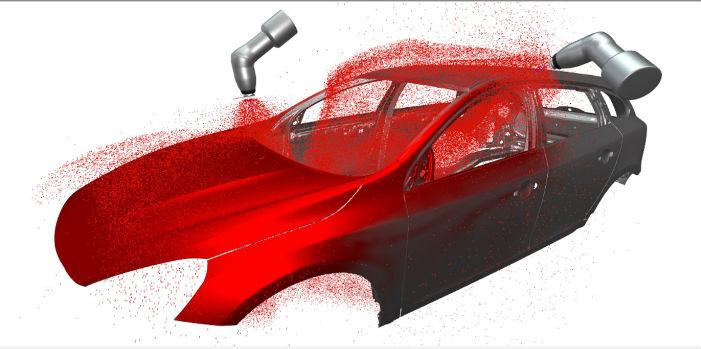
The researchers explain that automated painting is a five-step process. First, they use robust state-of-the-art systems to produce a three-dimensional exploration of the component. The data from this scan forms the basis for a fluid dynamics simulation: custom software simulates the trajectory of the paint particles and then determines the optimal volume of paint and air needed to achieve the required coating thickness. In the third step, the system uses the simulation data to plan the robot's trajectory for the painting process. The painting process itself takes place. In the fifth and final stage, the quality of the paint is inspected to verify that the required coating thickness has been reached.
While Fraunhofer IPA researchers are coordinating the project and focusing on both paint technology and simulation of paint particles near the atomizer, their colleagues in Sweden simulate the behavior of particles near the workpiece and work on automated planning. More specifically, they are calculating how paint droplets move through the air, where they are set on the target object and the thickness of the resulting coat of paint. At Fraunhofer ITWM, researchers are carrying out 3D scanning technology and coating thickness measurement for quality control purposes. The individual modules are now complete. Now, the researchers are working to combine the individual steps to form a fully automated process.
Expected to be completed by the end of 2018, the finished prototype is set to help increase the degree of automation and flexibility of painting technology in production.
Source: https://www.fraunhofer.de