
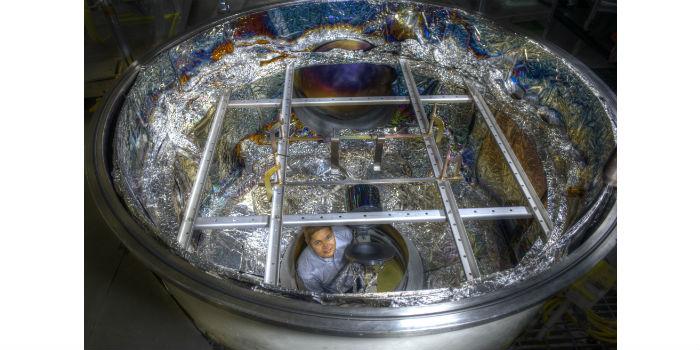
 United States. NASA technologists, led by Manuel Quijada and his team, are investigating techniques to create highly reflective aluminum mirrors sensitive to the infrared, optical and ultraviolet wavelength bands.
Quijada's team is specifically studying three different techniques and materials for creating and applying protective coatings on aluminum mirrors to prevent them from rusting when exposed to oxygen and losing their reflectivity.
"Aluminum is a metal that nature has given us the broadest spectral coverage," Quijada said. "However, aluminum needs to be protected from natural oxides with a thin film or substrate of transparent material."
Unfortunately, no one has developed a coating that effectively protects and maintains the high reflectivity of a mirror in the range of 90 to 130 nanometers, also known as the Lyman Alpha range. "The low reflectivity of the coatings in this range is one of the biggest limitations in the design of ultraviolet telescopes and spectrographs," Quijada said.
Quijada's goal is to develop a coating and process that not only improves reflectance in the far ultraviolet, but also allows observations in the other wavelength bands.
Under a coating approach, the team would use physical vapor deposition to apply a thin layer of xenon difluoride gas to an aluminum sample. According to Quijada, studies have shown that xenon difluoride treatment creates fluorine ions that bind tightly to the aluminum surface, preventing further oxidation.
It is also investigating the use of two other thin-film deposition techniques – physical ion-assisted vapor deposition and atomic layer deposition – to apply thin films of aluminum trifluoride, which is environmentally stable compared to other coatings.
Quijada and his team have already managed to develop a coating for another region of the spectral ultraviolet band.
In 2016, a validation test showed that a protective coating the team devised provided a 90 percent reflectance in the range of 133.6-154.5 nanometers — the highest reflectance ever reported for this ultraviolet band. To achieve this unprecedented level of performance, the team developed a three-step phased physical deposition process to coat aluminum mirrors with protective magnesium fluoride or lithium fluoride films.
These high-reflectance coatings are now enabling new types of instruments, Quijada said. Two new heliophysics missions will employ this coating technology.
Source: NASA.