
United States.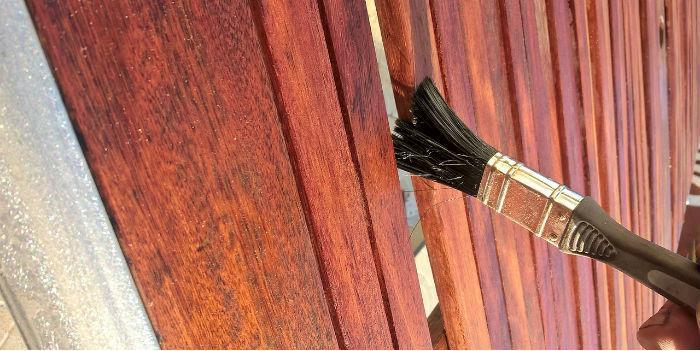 In a study published in the "Journal of Coatings Technology and Research", in collaboration with the American Coatings Association, the effects of the surface roughness of wood on the adhesion resistance of varnish layers have been tested.
Samples of beech wood (Fagus orientalis L.), Scots pine (Pinus sylvestris L.) and cherry tree (Prunus cerasus) were prepared and sanded with grain abrasives 80, 120 and 180. The surface roughness values of the specimens were determined using a Time TR 200 point-type profilometer, in accordance with ISO 4287 standards.
They then applied water-based, polyurethane and acrylic varnishes to the sample surfaces, in accordance with ASTM-D 3023. The adhesion resistance of the layer was determined according to TS EN ISO 4624 standards.
As a result they found that the highest adhesion strength value (2.52 N/mm2) in cherry tree, while Scots pine had the lowest value (2.32 N/mm2). For the types of varnishes, those of polyurethane varnishes gave the highest value (3.15 N / mm2), while the lowest value was obtained from the water-based varnish.
As for the interactions between adhesion strength and surface roughness, water-based varnish had the highest correlation with adhesion strength (69%) and acrylic varnish also had a similar result (67%), while polyurethane had the weakest result in this interaction (33%).
To learn about the study click here.