Argentina.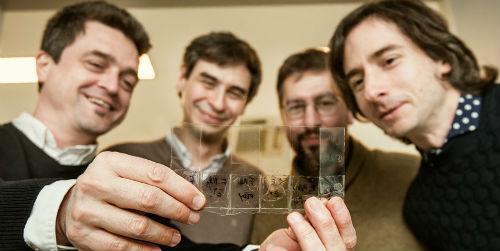 A group of researchers from the National Council for Scientific and Technical Research (Conicet) were distinguished by the development of an antibacterial coating. They received the Innovar 2016 Award in Applied Research for obtaining a long-lasting film that does not optically modify the surfaces to which it is applied.
Conicet's interdisciplinary and multi-institutional group of researchers basically developed a transparent coating with prolonged bactericidal effects that can be used to protect different surfaces, such as floors, walls, windows, countertops or doorknobs.
It is a very thin film containing nanometric pores charged with silver ions that are released when the surface is attacked by bacteria. "Silver is a chemical element that when in ionic form destroys the cell wall of many bacteria and alters their primary functions, without creating adaptation, so it is a very interesting species as an antibacterial," explains Galo Soler Illia, principal investigator of Conicet at the Institute of Nanosystems (INS, Unsam).
The thin film obtained by the researchers has the virtue of not optically affecting the surfaces on which it is placed, which is not a minor fact when it is expected to be a development that goes beyond the limits of the laboratory and can have an effective arrival in community life.
The first thing they tried was to generate silver nanoparticles in the pores of the coating, but they saw that although it was very efficient to avoid the colonization of bacteria, the film took on a brownish color. This was an aesthetic problem, but also functional if you wanted, for example, to protect a window.
"Then we tested by directly placing the silver ions in the pores and we saw that in this way the bactericidal effect was maintained and the transparency of the film was preserved," says Paolo Catalano, conicet adjunct researcher at the National Atomic Energy Commission (CNEA) and first author of the article recently published in Microporous and Mesoporous Materials in which he realizes the development. A patent was also filed for applications in glass coatings, tiles and surfaces.
Using silver nanoparticles as a reservoir for silver ions to release them to the extent necessary to kill bacteria is common in nanotechnology. According to Soler-Illia, the novelty of this development was to use directly as a reservoir the pores of a transparent coating that can be applied to any surface, and that controls the release of the active ingredient.
Another advantage of the developed coating is its long service life. In the experiments carried out at the laboratory level, it was successfully subjected to ten cycles of colonization by bacteria over five months and at the end of the tests there was still a remnant of silver ions in the pores. And even once the silver runs out, they could be recharged.
"The nanopores can have different sizes, but the important thing is that being so small they can cover a significant percentage of the film, between 20 and 50%, which allows to accommodate a lot of the bactericidal compound," says Catalano.
The nanoporous film in which the silver ions are charged is prepared based on a solution of titanium dioxide and silicon dioxide and adheres to the surfaces to which it is applied in the same way as an enamel.
The researchers are optimistic about the social impact that the application of this development could have: "It is a simple and inexpensive technology that would allow, for example, to lower the rate of hospital infections," concludes Soler-Illia.
Patent
Martín Bellino, independent researcher of Conicet at the National Atomic Energy Commission (CNEA) and Martín Desimone, independent researcher of the Council at the Institute of Chemistry and Drug Metabolism (Iquimefa, Conicet, UBA), agreed to highlight that this development is part of a patent application for applications in glass coatings, tiles and surfaces. The patent application, managed by the Directorate of Technological Linkage (DVT) of Conicet, is under evaluation at the National Institute of Industrial Property (INPI).
Source: Conicet.