
United States.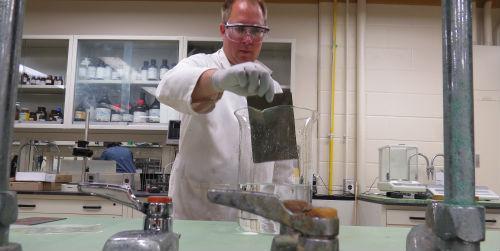 A chemist at Brock University and a Burlington chemical company have patented a green coating system that protects metals against corrosion.
Organic chemistry instructor Paul Zelisko and Vanchem Performance Chemicals created the technology they called Greencoat, which uses silicon instead of heavy metals to attach coatings to metal surfaces and paint.
"It's a water-based system that, for all intents and purposes, has reactive sand," Zelisko says. "If the material becomes purged or leaks, you are effectively releasing sand and water into the environment."
Sheets made of steel or other metals have to be 'pre-treated' with a substance that will protect them against damage caused by oxidation and salt. This substance must be able to stick not only to the metal, but also to any type of paint that is applied to the sheets on top of the coating.
The challenge is that metal is an inorganic substance, meaning it is not made from a plant or animal, but the paint that is applied to the metal is an organic substance.
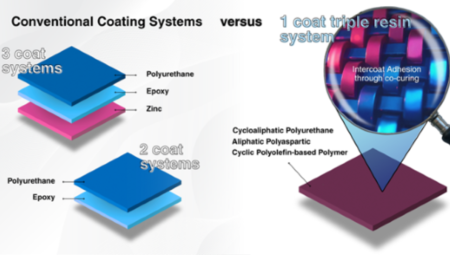
Unlike conventional methods, the Zelisko and Vanchem system involves the following process:
- First, a base layer is applied to the metal.
- The water is mixed with silica, which is basically sand, then sprayed onto the metal, creating a chemical bond with the metal.
- The metal is cleaned but silica is also deposited on the surface.
- The coating also acts as a primer for the second layer, which is designed to adhere well to the paint.
- The second layer contains polysilicates, the basis of what is silicon.
Silicates can be modified to stick to metals and paints.
When the industry wants to determine whether or not it is an effective coating product, the treated metal sheets are put into salt spray chambers, where a fine saltwater mist is continuously sprayed onto the metal until it begins to show signs of corrosion.
The industry standard is about a thousand hours, Zelisko says. "Our coatings contained between 1,800 and 3,000 hours, in some cases almost three times as good as the industry requires."
When it comes into contact with the metal, the salt water acts as a type of catalyst, allowing oxygen to mix with the metal, resulting in corrosion.
Source: Brock University.