
International.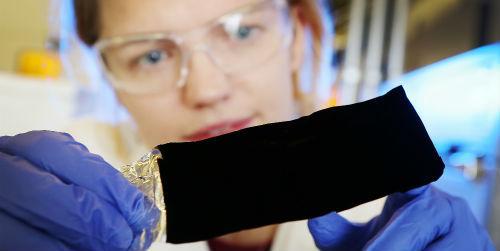 A company located in the United Kingdom, which about 3 years ago had developed what they call the blackest coating in the world, announced that it has now launched a new version of the spray product, known as Vantablack S-VIS.
Vantablack's nanostructure absorbs virtually all incident light, allowing the performance of precision optical systems to be optimized. The developer of the material, Surrey NanoSystems, has mimicked the performance of its original Vantablack with a new version that can be sprayed on objects, instead of being deposited using a chemical vapor disposal (CVD) process.
Vantablack S-VIS considerably expands the potential for a range of applications, making it possible to coat large structures and complex shapes. It is applied at temperatures easily supported by common plastics, further extending its use. Even though the material is applied using a simple spray process, it traps a massive amount of 99.8% of the incident light. This property gives Vantablack S-VIS its ability to make objects have the appearance of two-dimensional black holes, since it becomes almost impossible to discern the topography of their surface.
The only material available that is darker than the new S-VIS version is the original Vantablack, which broke a world record for light absorption at an astonishing 99.965%. Vantablack was originally developed for Earth observation images taken from satellites and for calibration systems, where it increases the sensitivity of instruments by improving the absorption of visible ultraviolet spectrum and infrared light. Since then, many other applications have emerged, including solar energy collectors, functional surfaces in buildings and architecture, film projectors, high-performance lenses and baffles, and scientific instruments. His ability to trick the eye also opens up a range of design possibilities to enhance the style and appearance of luxury goods and jewelry.
"The original Vantablack coating has had a huge impact on the market, and is helping many companies to build higher-performing equipment," said Ben Jensen of Surrey NanoSystems. "We are continuing to develop technology, and the new applicable spray version really opens up the possibility of applying super-black coatings in many more types of aerial or terrestrial applications. Possibilities include commercial products such as cameras, equipment that requires improved performance in a smaller form factor, as well as, to differentiate the appearance of products by means of a coating of a unique aesthetic appearance. It's a breakthrough compared to commercial absorption coatings today."
Vantablack S-VIS achieves a reflection of less than 0.2%. Unlike other dark absorption materials, it offers its desemepeño along a wide range of viewing angles and wavelengths, which is critical for optical instruments, as well as in many aesthetic applications. It is, for example, about 17 times less reflective than the super-black paint used to minimize the light scattered on the Hubble Space Telescope.
The active element of Vantablack S-VIS is a matrix of carbon nanotubes. The coating is applied using a proprietary process that includes a set of pre- and post-application steps to achieve its ultra-low reflectance.
Source: www.surreynanosystems.com