
United States.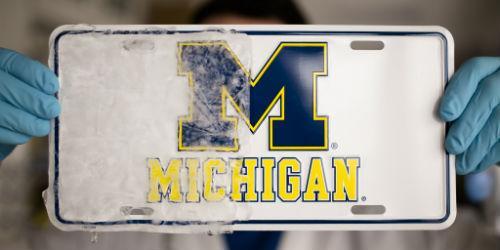 Scientists at the University of Michigan developed a durable, inexpensive ice-repellent coating, the aerosol formula could cause ice to slide onto the surface of a car or airplane windshield, with just the force of gravity or a gentle breeze.
This could have major implications in industries such as energy, marine and land transport, where ice is a constant problem in cold climates.
Made from a mixture of common synthetic rubbers, the formula marks a departure from previous approaches that were based on the manufacture of surfaces that were either very water-repellent or very slippery.
The team of scientists initially experimented with surfaces that repel water as well, but found that they were not effective at ice spillage. However, during their experiments, they realized something unexpected: rubber coatings worked best to repel ice, even when they were not water repellent. Eventually, they found that the ability to repel water was not important at all. Rubber coatings repel ice due to a different phenomenon, called "interfacial cavitation."
They also explained that two rigid surfaces— ice and the car's windshield—can stick tightly together, needing a great deal of force to break the bond between them. But due to interfacial cavitation, a solid material stuck to a rubber surface behaves differently. Even a small amount of force can deform the rubber surface, breaking the free solid.
The new approach makes it possible to dramatically improve durability compared to previous ice phobic coatings, which relied on fragile materials that lost their ice-shedding abilities after a few freeze-thaw cycles. The new coatings were part of a variety of laboratory tests, including peeling tests, salt spray corrosion, high temperatures, mechanical abrasion and hundreds of freeze-thaw cycles.
To observe a demonstration you can click here.