
International.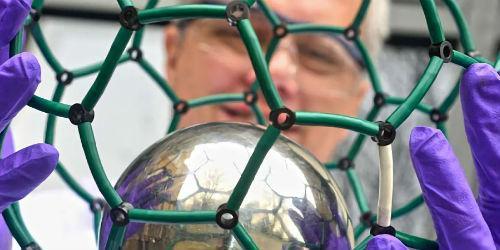 Scientists at the University of Oxford in the UK announced that a spin-off lab called Designer Carbon Materials is now producing endohedraal fullerenes, and recently sold their first sample of the material to the tune of $32,000 per 200 micrograms, which is about one-fifteenth the weight of a snowflake. or one-third the weight of a human hair.
First discovered in 1985, endohedral fullerenes are spherical carbon nanostructures consisting of a robust fullerene cage made of 60 carbon atoms, within which atoms of nonmetallic elements or simple molecules, such as nitrogen, phosphorus, and helium, are trapped.
These things aren't just exaggeratedly expensive curiosities – when they contain nitrogen atoms, they actually have the potential to change the way time is maintained, due to the extra long lifespan of electrons.
Scientists are now investigating the possibility of using them in atomic clocks – the world's most accurate timing systems – and the Oxford team hopes that in the future, they could be used to make all sorts of devices more accurate than ever.
That's because endohedral fullerenes have the potential to reduce the size of atomic clocks from the size of a cabinet to a microchip, so you could install them on our phones or integrate them with our GPS devices, for example.
Image taken from www.omicrono.com