
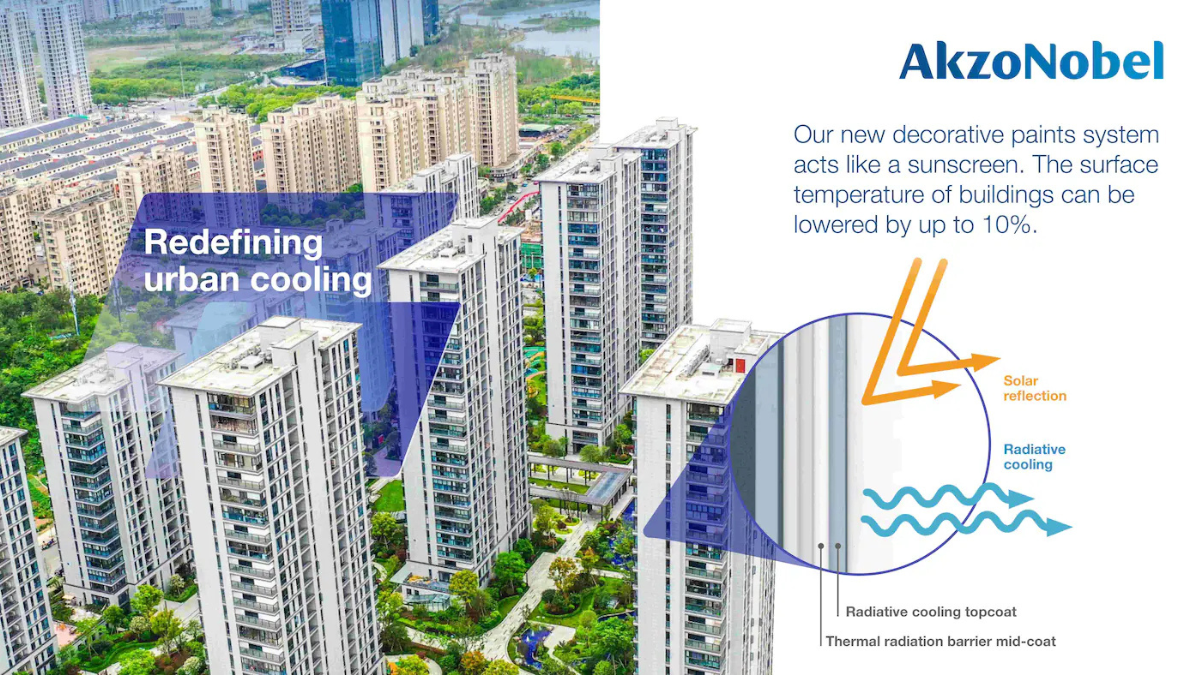
International. AkzoNobel presented in China a new thermally insulated coating system, designed to lower the surface temperature of buildings and improve their energy efficiency. This development incorporates a radiative cooling top layer and a thermal radiation barrier middle layer.
The technology, developed by the company's Decorative Paints division, seeks to reduce the surface temperature of buildings by up to 10% during the summer months, compared to conventional coatings.
The mechanism is based on passive radiative cooling, a process that allows heat lost through thermal radiation to be emitted into outer space. According to the company, this innovation is expected to have a positive impact on energy savings, especially in the modernization of existing buildings. The technology was tested on buildings in the Lingang section of the Shanghai Pilot Free Trade Zone.
"This is a significant advancement in architectural coatings and opens up new avenues for the renovation of energy-efficient buildings," said Karen Yin, head of the China North Asia Decorative Paints business and president of AkzoNobel China. "Our goal is to provide consumers with safer, more sustainable and comfortable living environments, while contributing to China's dual-carbon policy, which focuses on both controlling total emissions and carbon intensity."
The middle layer of the system uses aerogel, a material with low thermal conductivity that acts as a barrier against heat transmission and penetration. The top layer, an improved version of thermo-reflective coatings, offers higher reflectivity and high thermal emittance, allowing heat to be emitted directly into the atmosphere. This helps to reduce the urban heat island effect. Both coatings are low in volatile organic compounds (VOCs) and formulated entirely water-based.
"The science behind these 'cold coatings' can be complex, but their effect is easily explained," Yin added. "A 'normal' outer coating gets hot in the sun, as it absorbs some sunlight. A thermoreflective coating heats up less, as it absorbs less sunlight. Our new cold coatings do not heat up at all, as they hardly absorb sunlight and dissipate heat efficiently."
According to AkzoNobel, the built environment is responsible for around 40% of annual global carbon emissions. In this context, this technology could represent a contribution to improving the sustainability of buildings in hot climates.