
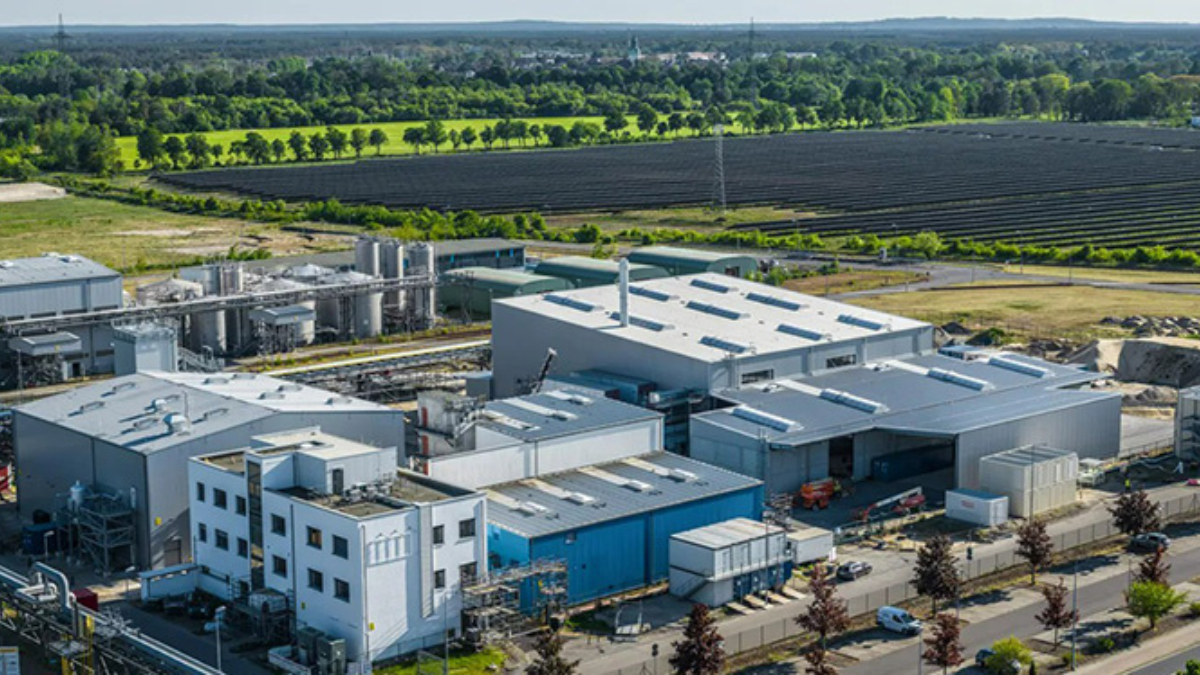
International. BASF announced the start of commercial operations of two new industrial plants: a Black Mass battery recycling plant in Schwarzheide, Germany, and a hexamethylenediamine (HMD) plant in Chalampé, France.
In Germany, the Black Mass plant has an annual processing capacity of up to 15,000 tonnes of end-of-life lithium-ion batteries and production waste, which is equivalent to around 40,000 EV batteries per year. The production process is based on the mechanical treatment of batteries to generate black mass, which contains metals such as lithium, nickel, cobalt and manganese. These can be recovered and reused to produce cathode active materials (CAM).
"Our new Black Mass plant is further proof of our commitment to the battery materials and recycling industry, which remains one of the most significant growth opportunities in the chemical industry and for BASF Battery Materials. It will become a cornerstone of our offer to our customers to increase the self-sufficiency of raw materials and comply with the EU Battery Regulation," said Dr. Daniel Schönfelder, President of BASF's Battery Materials division.
BASF's offer in Europe in battery recycling includes collection, discharge, decommissioning, production and refining of black mass, supported by a network of partners and the company's own infrastructure. Schwarzheide also operates an automated CAM plant, a prototype metal refinery and a black mass storage center.
In Chalampé, France, BASF commissioned a hexamethylenediamine (HMD) plant, construction of which began in 2022. The new facility increases the company's total HMD production capacity to 260,000 metric tons annually.
"This investment underscores BASF's strong commitment to chemical production in Europe and our determination to support regional growth. It is yet another example of how we are implementing our 'Winning Ways' strategy to create long-term value for our company and ensure our future competitiveness in a volatile economic environment," said Dr. Stephan Kothrade, Member of the Board of Management of BASF.
The plant is part of the company's strategy for the polyamide (PA) 6.6 business in Europe. BASF is also in the final phase of expanding its PA 6.6 production in Freiburg, Germany.
"The successful completion of this investment project is a significant step towards our goal of being the leading HMD supplier and preferred partner of PA 6.6 in Europe," said Dr. Ramkumar Dhruva, President of BASF's Monomers division. "Thanks to the new HMD production plant in Chalampé and the expansion of the PA 6.6 polymerization in Freiburg, we are ideally placed to reliably supply our customers with high-quality products."
HMD is a precursor used in the manufacture of PA 6.6 polymers and in raw materials for coatings. These products are applied in sectors such as the automotive industry and fiber production. In Chalampé, BASF also manages a research and development laboratory linked to these materials.