
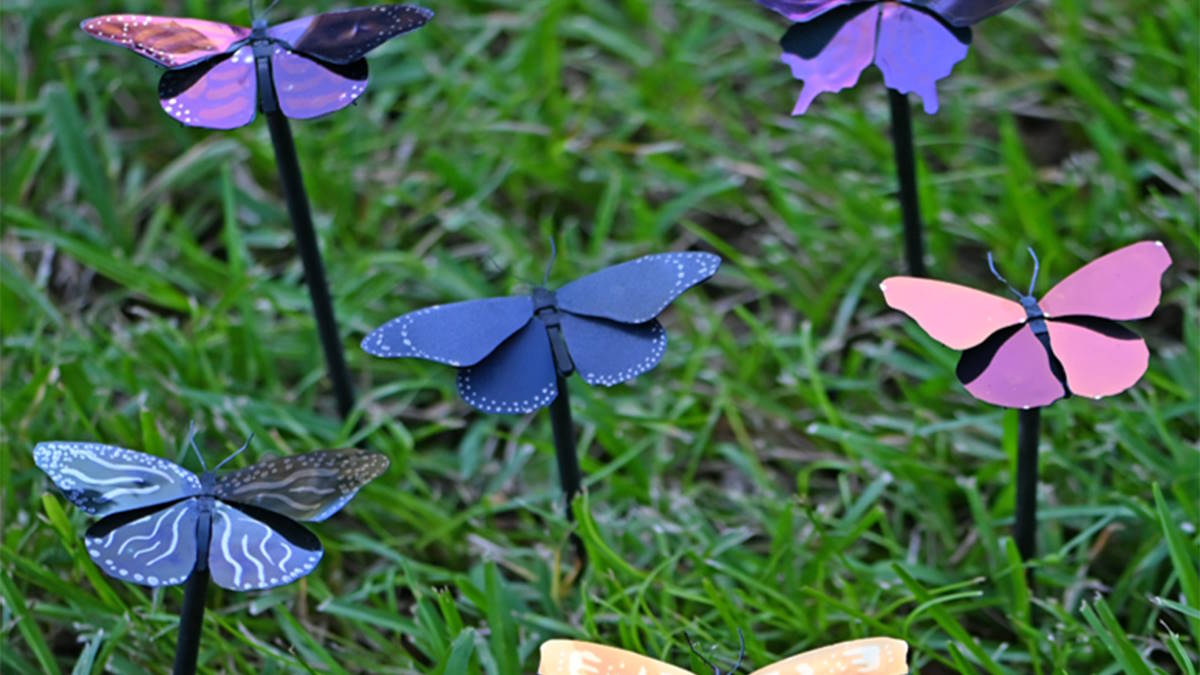
International. A team of researchers from the University of Central Florida developed the lightest paint to date, known as "plasmonic paint," inspired by butterfly wings.
This paint repels heat, can be manufactured in any color and is expected to last for centuries. The study was published in the scientific journal Science Advances.
Unlike conventional pigment-based paints, plasmonic paint does not use molecules to produce color. Instead, it uses nanoparticles of two colorless materials: aluminum and aluminum oxide.
The university's nanoscientists structurally arranged these two materials on an oxide-coated aluminum mirror to control the reflection, absorption, and scattering of light. This process is similar to that responsible for the vivid colors of butterfly wings.
According to the authors, to cover a Boeing 747 aircraft would need only 1.4 kilograms of plasmonic paint, instead of the 454 kilograms of conventional paint. In this way, the new paint could significantly reduce greenhouse gas emissions in the aviation industry.
In addition, it has the ability to keep surfaces cooler thanks to reflecting the entire infrared spectrum and reducing heat absorption. Surfaces covered with this paint are kept 13 to 16 degrees Celsius cooler than those covered with conventional paint, which could lead to significant energy savings.
The team, led by Debashis Chanda argues that plasmonic painting has great potential to be used in various sectors and contribute to the fight against climate change.
To create the plasmonic paint, the scientists used an electron beam evaporator that heats a substance at a very controlled rate. This allowed small groups of aluminum nanoparticles to self-assemble. By adjusting the pressure and temperature of the evaporator, they were able to create structures that reflect different colors.
Subsequently, they combined their flakes of structural color with a commercial binder, which ensured their durability for hundreds of years. The color of normal paints fades because the pigment loses its ability to absorb photons, but the structural color does not cope with that phenomenon.
Although plasmonic paint has only been created in the lab, the team has fabricated several colors using techniques that can be replicated. However, there is still a long way to go before you can find it on the market.
Currently, pigment-based paint is made in large facilities where hundreds of gallons can be produced, while plasmonic paint production is not cost-effective.
The study opens up new possibilities for sustainable and energy-efficient paints that help reduce the environmental impact of human activities. If scaled up, plasmonic painting could have major implications for the aviation, construction and transportation industries.
It is not the first time that a type of paint with incredible properties has been developed. A few years ago Vantablack was created, one of the blackest paintings in the world capable of absorbing 99.96% of light. There is also the ultra-white version, which reflects 98.1% of all light.