
 International. The Fraunhofer Institute for the Microstructure of Materials and Systems IMWS in Halle (Saale), Germany, is conducting research that points towards a sustainable, environmentally friendly and resource-saving way of life. Together with industry partners, it is developing, for example, surface coatings that prevent the biofouling process.
This summer, due to the persistent drought, people in some places were advised to save on water use. Something that happens very rarely in Germany, and is limited to particular areas, is a constant problem in other countries without freshwater springs. "Drinking water, as a valuable commodity globally, must be included in the efficient and sustainable use of limited resources," says Project Director Ulrike Hirsch of the Fraunhofer Institute for the Microstructure of Materials and Systems IMWS in Halle. In 2017, his team received the Hugo-Junkers Innovation Award from the State of Saxony-Anhalt for their research on more efficient methods of producing drinking water. He developed coated components for membrane modules by means of which seawater and brackish water are transformed into drinking water through the principle of reverse osmosis.
Its industrial cooperation partner is IAB Ionenaustauscher GmbH of Bitterfeld in Saxony-Anhalt. This subsidiary, 100% of Lanxess, manufactures membrane filtration elements for water processing, among other things. It's not the first time the Halle and Bitterfeld teams have worked together. "When it comes to applied research in the field of material efficiency, the Fraunhofer Institute is a capable driving force and problem solver for industry," emphasizes Carsten Schellenberg. He is the Managing Director of IAB Ionenaustauscher GmbH and is responsible for the research and development work at the Bitterfeld site. Companies, especially from the fields of medical technology, pharmacy, biotechnology and plastics processing, seek cooperation with Fraunhofer IMWS in the area of surface modification. Its core competencies lie in material development, among other things. The common goal is the development of viable materials for the future, which are sustainable and environmentally friendly, and which lead to the responsible and efficient handling of limited raw materials.
Membrane separators: with a feeling of greater efficiency
Experts from IAB and Fraunhofer IMWS are conducting joint research in the "Innovative Membrane Spacer" project in the optimization of modules for the processing of brackish water and seawater. "Membrane spacers are the spacers between membranes that form water flow paths," explains Magdalena Jabłońska, a scientist employed at Fraunhofer IMWS. However, these spacers are also very prone to the accumulation of suspended matter, salt crystals and microorganisms, she says. The so-called biofouling, it continues, leads to blockages and a reduction in performance, up to the failure of the membrane modules. Research partners are developing hydrogel-type coatings for spacer surfaces. Like a barrier, they are intended to prevent the adhesion of suspended materials and microorganisms.
"If the biofouling process slows down or stops, there is less material damage, lighter wear on the modules and a lower maintenance requirement. This saves energy and costs," says Magdalena Jabłońska. The findings obtained under the joint project will be incorporated into the industrial processes at the Bitterfeld site in Lanxess.
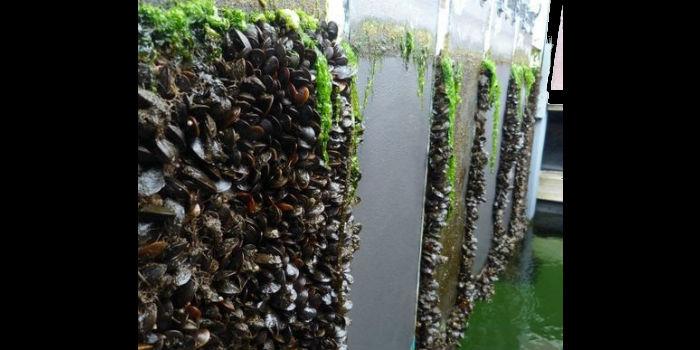
Biofouling is not just a problem with water filtration modules. The bases of offshore wind turbines or drilling rigs, and especially the hulls of ships, are also subject to biofilm growth. The thick crust of microorganisms, algae, mussels and barnacles attacks the concrete foundations and significantly increases the fuel consumption of ships.
Optimization of surfaces against biofouling
At the Fraunhofer IMWS in Halle there is a facility for the optimization of special surface paints designed to prevent this biofouling. The partners in this project are the Institute of Plastic Technology and Recycling IKTR, the Society for the Promotion of Medical, Biological and Environmental Technologies GMBU Halle, Bioplan GmbH, NTC NanoTechCoatings GmbH and Schiffswerft Barth.
The "above anti-fouling paints," says project manager Uwe Spohn, "often contain poisonous substances that dissolve in water and are harmful to sea dwellers." In our facilities we are optimizing a new generation of paints that works completely without poisonous addictive substances." The great thing about these surface coatings is their electrical conductivity. The project manager explains: "The paint system consists of several layers through which a direct current of a few milliamps per square centimeter flows. The outer layer acts as an anode in which oxygen is formed. The pH value sinks into this acidic environment. After the polar reversal of the current flow, the outer layer of paint becomes a cathode in which hydrogen is produced, forming an alkaline medium. The pH value increases. Regular changes at certain time intervals subject microorganisms to a pH-stress that makes it difficult for them to settle." Or, to put it another way: the ship's steel remains free of vegetation, preventing the vessel from gaining weight on the high seas. This makes it possible to avoid higher fuel consumption, additional emissions of pollutants, longer travel times, less manoeuvrability, more frequent maintenance of the vessel and, above all, an increase in costs.
This electrically conductive antifouling paint system has already proven its stability in a long-term test in the Baltic Sea. An initial test has also been a success. Project partners are now optimizing the technology so that entire ships can be coated with paint in shipyards.
Source: Saxony-Anhalt.