
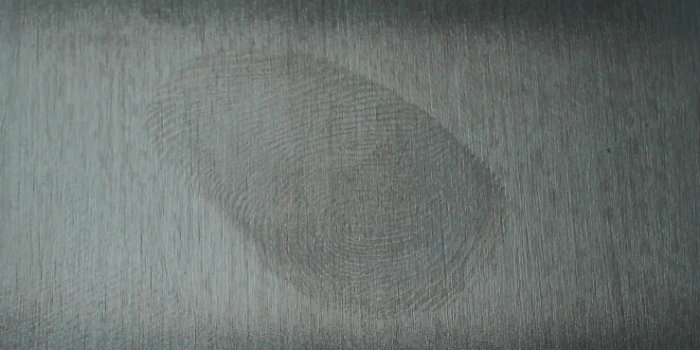
 Germany. Researchers at the Fraunhofer Institute for Microstructure of Materials (IMWS) are developing a new layer of nanolayers that will prevent grease stains caused by touching stainless steel surfaces with your fingers, affecting the aesthetic appearance of different appliances with this type of finish and that can also damage the metal surface.
The secret is in a coating layer that contains special additives and is water and oil repellent. The effects of this layer are twofold: when the particles integrated into the coating settle on the surface of the stainless steel, the surface becomes rougher and its surface area increases.
Thus, when a finger comes into contact with the refrigerator door, it only touches the raised points of the surface and the grease of the fingertips never reaches the low areas of the stainless steel surface, that is, the surface that actually comes into contact with the grease is very small.
This development is carried out in conjunction with scientists from FEW Chemicals, who are in charge of the coating systems, while Fraunhofer concentrates on the analysis of these layers. "We are investigating the layers created using optical microscopy, scanning electrons and atomic force. We looked at how large the individual particles are in the coating system and whether or not they are homogeneously distributed," says Jessica Klehm, research associate in the Biological and Macromolecular Materials business unit at Fraunhofer.
The research had to overcome several challenges, such as reducing the size of the samples, which had to be no more than 60 to 80 micrometers thick, that is, about the thickness of a human hair, while examination under an electron microscope requires a sample a thousand times thinner. "We can't cut the samples to size using a saw, which would destroy the coating. Therefore, we embed the samples in resin and then crush them to the desired thickness," explains Klehm.
So far, the researchers have already found a promising system among the various coatings tested, and the task now is to further optimize the system. Development activities are due to be completed by the end of 2020, when industrial-scale production will be delivered to FEW Chemicals.