
 United States. Chemists at the University of Chicago have created the first catalyst to break certain carbon-carbon bonds. This breakthrough may one day open up possibilities for making chemicals from plants rather than oil, by creating a new method for breaking certain carbon-to-carbon bonds.
A large number of chemicals in the natural and industrial world have backbones made of carbon-on-carbon bonds. These are regularly divided during processes to create useful new molecules. But a particular subset of these links is very stable and therefore difficult to open. Chemists would like to discover new ways to cut and reorganize such links; a library of such knowledge is key to finding valuable new chemicals or more efficient or greener ways to make the best known known known.
For example, lignin, a molecule found in plants and trees, has long been considered an alternative source of chemicals produced from crude oil, which are used to make plastics and fertilizers. But it contains many of these especially hard carbon-carbon bonds. "If we had an efficient method to break those bonds, we could make full use of lignin as a sustainable alternative to oil," said Guangbin Dong, a professor of chemistry at UChicago and a co-author of the study.
The problem is that carbon-carbon bonds are often connected with particularly strong non-polar bonds. If they could be placed in certain configurations that allow close interaction with a metal catalyst, they can break. But before the study, no catalyst was known to be able to break such unfettered nonpolar bonds in lignin.
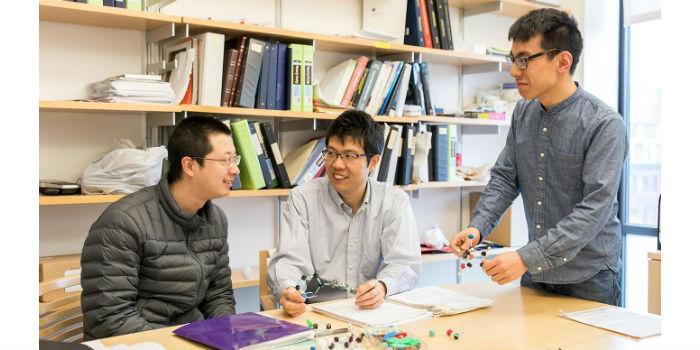
Dong, along with postdoctoral researcher Jun Zhu and graduate student Jianchun Wang, devised a new method for using a metal hydride catalyst to break bonds. The metal hydride acts as an active intermediate, is inserted into the carbon bonds and then also attached to hydrogen.
The method itself is not suitable for commercial use, but it provides a proof of concept for the future, the scientists said.
"This provides an opening for further study of such methods," Dong said. "Fundamentally, we want to know the limits of what kind of carbon-carbon credits could be activated."
Data Source Provider: University of Chicago.