
 United States. Scientists at the Massachusetts Institute of Technology (MIT) have developed a passive solar energy system that could prevent ice from freezing or accumulating on airplanes, wind turbines, power lines and other surfaces.
Preventing that buildup usually requires energy-intensive heating systems or chemical aerosols that are harmful to the environment. Now, MIT researchers have developed a completely passive, solar-powered way to combat ice buildup.
The system is remarkably simple, based on a three-layer material that can be applied or even sprayed on the surfaces to be treated. It collects solar radiation, converts it into heat and propagates that heat so that fusion is not limited to areas directly exposed to sunlight. And, once applied, it requires no further action or energy source. You can even do your defrost job at night, using artificial lighting.
The new system was described in the journal Science Advances, in a paper by MIT associate professor of mechanical engineering Kripa Varanasi and postdoc, Susmita Dash and Jolet de Ruiter.
"Ice formation is a major problem for aircraft, wind turbines, power lines, offshore oil platforms and many other places," Varanasi says. "The conventional ways to avoid it are de-icing sprays or heating, but those have problems."
The defrosting aerosols common for aircraft and other applications use ethylene glycol, a chemical that is not environmentally friendly. Airlines don't like to use active heating, both for cost and safety reasons. Varanasi and other researchers have investigated the use of superhydrophobic surfaces to prevent ice formation passively, but those coatings can be affected by frost formation, which tends to fill the microscopic textures that give the surface its ice-melting properties.
As an alternative line of research, Varanasi and his team considered the energy emitted by the sun. They wanted to see, he says, if "there's a way to capture that heat and use it in a passive approach." They found out it did.
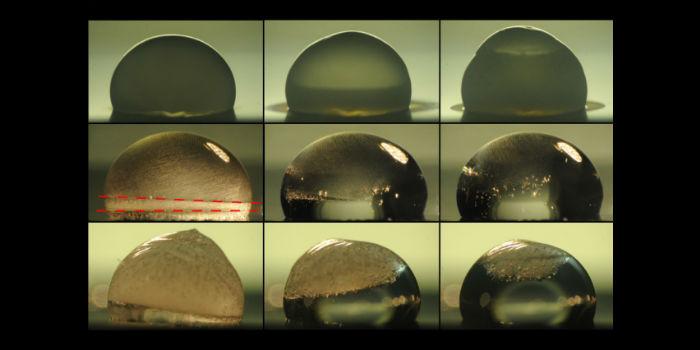
You don't need to produce enough heat to melt most of the ice that forms, the team found. All that is needed is for the boundary layer, right where the ice meets the surface, to melt enough to create a thin layer of water, which will make the surface slippery enough for the ice to slide immediately. This is what the team has achieved with the three-layer material they have developed.
The top layer is an absorbent that traps incoming sunlight and converts it into heat. The material used by the team is highly efficient, absorbing 95 percent of incident sunlight and losing only 3 percent of radiation, Varanasi says.
In principle, that layer could help prevent frost formation, but with two limitations: it would work only in areas directly in sunlight, and much of the heat would be lost in the substrate material : the wing of the plane or power line, for example, and would not help with thawing.
Therefore, to compensate for the location, the team added a spreader layer, a very thin layer of aluminum, barely 400 micrometers thick, which is heated by the absorbent layer above it and distributes heat very efficiently laterally to cover the entire surface. The material was selected to have "a thermal response that is fast enough for heating to take place faster than freezing," Varanasi says.
Finally, the bottom layer is simply foam insulator, to prevent heat from being wasted and keeping it where needed, on the surface.
The three layers, all made of cheap material available on the market, are joined together and can be attached to the surface that needs to be protected. For some applications, materials could be sprayed onto a surface, one layer at a time, the researchers say.
Source: MIT.