
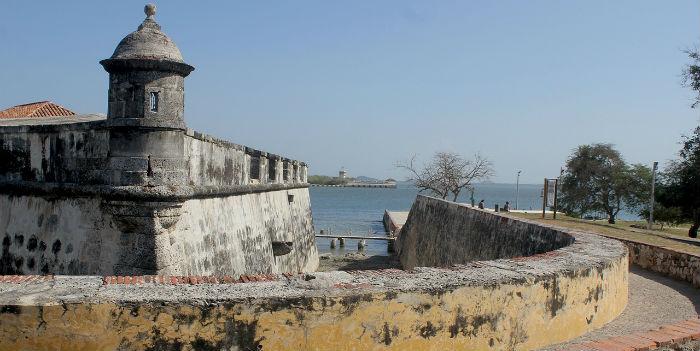
 Colombia. A study carried out by researchers from the University of Cartagena specifies the causes that influence what could be called disease of the walls, and makes recommendations for the best conservation of the monuments constituting the monumental heritage of the city of Cartagena. That is why it has considered the use of a suitable paint for its protection.
The special coating based on silicon and titanium is suggested as a protective mechanism of the walls of the biodegration to which this heritage scenario would be exposed on account of the multiple microorganisms, which according to the study of the researchers inhabit the interior of the walled cord.
The Laboratory of Research in Catalysis of Materials of the University of Cartagena set off this week the alarms about the presence of the so-called 'black crust', a kind of bacterial ecosystem that feeds on the coral rock from which the wall is made, and that in the long term could generate serious damage to the structure of the walled cord.
Roy David Tatis, master in chemistry and member of this research laboratory, was in charge of developing and producing a kind of coating 'paint', whose effectiveness has already been tested at laboratory scale, and which would have an approximate production value, ranging between 1,800 and 2,000 billion pesos (about US $ 648,000), to be applied in the 3.2 kilometers that make up the wall.
Tatis explained that this material works as a photocatalyst that in the presence of sunlight generates other chemical substances that protect the rocks from pollutants.
Source: El Heraldo - University of Cartagena.