
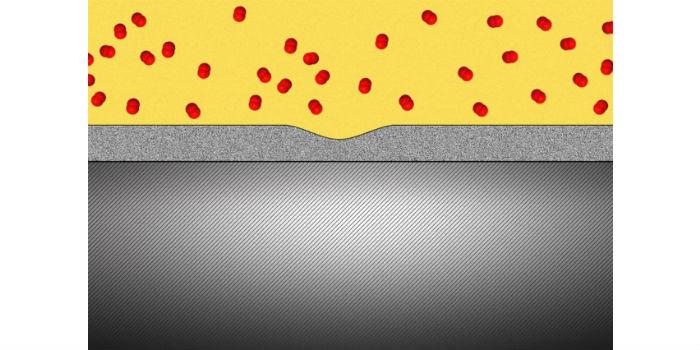
 International. Researchers have found that a solid oxide protective coating for metals can, when applied in thin enough layers, deform as if it were a liquid, filling any cracks and spaces as they form.
The thin coating layer should be especially useful in preventing the seepage of tiny molecules that can penetrate through most materials, such as hydrogen gas that could be used to power cars with fuel cells or radioactive tritium (a heavy form of hydrogen) that forms inside the cores of nuclear power plants.
Most metals, with the notable exception of gold, tend to oxidize when exposed to air and water. This reaction, which produces rust in iron, tarnish in silver and cardenillo in copper or brass, can weaken the metal over time and lead to cracks or structural failures. But there are three known elements that produce an oxide that can actually serve as a protective barrier to prevent any further oxidation: aluminum oxide, chromium oxide, and silicon dioxide.
Ju Li, a professor of nuclear engineering and science, and materials science at MIT and lead author of a paper describing the new finding, says "we were trying to understand why aluminum oxide and silicon dioxide are special oxides that provide excellent corrosion resistance." The document appears in the journal Nano Letters.
The team, led by MIT graduate student Yang, used highly specialized instruments to observe in detail the surface of metals coated with these "special" oxides to see what happens when they are exposed to an oxygen-rich, low-stress environment. While most transmission electron microscopes (MET) require samples to be studied in high vacuum, the team used a modified version called environmental TEM (E-TEM) that allows the sample to be studied in the presence of gases or liquids of interest. The device was used to study the process that can lead to a type of failure known as stress corrosion cracking.
Metals under pressure stress inside a reactor vessel and exposed to a superheated steam environment can corrode quickly if not protected. Even with a solid protective layer, cracks can form that allow oxygen to penetrate the bare metal surface, where it can penetrate the interfaces between the metal grains that make up a bulk metal material, causing additional corrosion that can penetrate deeper and lead to structural failure "We want an oxide that is liquid and crack-resistant," Yang says.
It turns out that the old standby coating material, aluminum oxide, can have that liquid-like fluid behavior, even at room temperature, if it is turned into a thin enough layer, 2 to 3 nanometers (billionths of a meter) thick.
The researchers demonstrated inside the E-TEM that aluminum with its oxide coating could stretch to more than twice its length without causing cracks to open, Li says. The oxide "forms a very uniform layer of conformation that protects the surface, with no grain limits or cracks," even under the stress of that stretch, he says. Technically, the material is a type of glass, but it moves like a liquid and completely coats the surface, as long as it is thin enough.
The self-healing coating could have many potential applications, Li says, pointing to the advantage of its smooth, continuous surface without cracks or grain boundaries that could penetrate the material.
Source: MIT.