
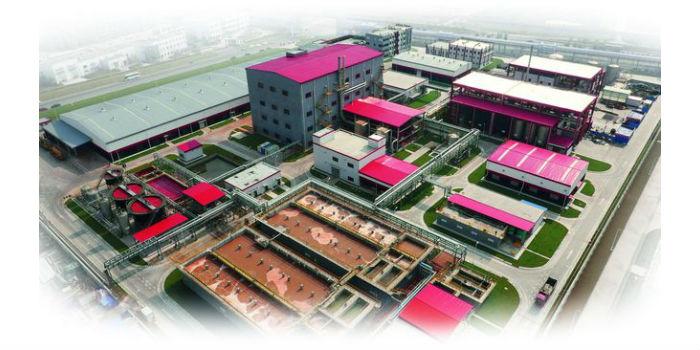
 International. Lanxess recently received the national green plant certificate for its plant in Ningbo, from the Ministry of Industry and Information Technology (MIIT) of the People's Republic of China. The Ningbo plant is located in the Ningbo Petrochemical Economic and Technological Development Zone (NPETD), a nationwide chemical park that ranks third in China.
The National Green Plant certificate is a key element of China's Green Manufacturing System, which aims to accelerate industrial development while maintaining high environmental standards. This seal of quality is awarded to only one thousand best-in-class companies that have demonstrated a clear commitment to sustainability in their respective industries by implementing state-of-the-art technology and environmentally friendly practices in their production facilities. "Our plant in Ningbo sets a benchmark for the entire sector and achieves outstanding values, particularly with its low emissions and energy consumption per tonne of product," says Holger Hüppeler, head of the Inorganic Pigments business unit at Lanxess.
At its certified production site in China, Lanxess has installed the newly developed Ningbo Process. The production process is based on patented technology and ensures the most environmentally friendly production of yellow-toned synthetic iron oxides in Asia. Compared to traditional production methods, this process produces significantly less nitrogen oxide, including extremely harmful laughing gas. In addition, the remaining greenhouse gas emissions are completely purified by highly efficient aftertreatment equipment. "Therefore, Lanxess makes a measurable contribution to the environment. The unfiltered laughing gas is currently generated by Penniman's production process for red iron oxide pigments in China which accounts for up to 7.6 million metric tons of CO2 equivalents per year. If every production facility used our Ningbo Process, the reduction of this greenhouse gas would be equivalent to the total annual CO2 emissions of 300,000 Chinese households," explains Hüppeler.
China boosts green manufacturing
In its thirteenth five-year plan (2016-2020), China promotes renewable energy and better use of resources to reduce environmental pollution. The government's goal is to push the Green Manufacturing System in the direction of the Made in China 2025 industrial modernization program in the coming years to catch up with major industrialized nations. For example, stricter environmental conditions should lead to a 22% reduction in CO2 emissions, an 18% reduction in energy consumption and a 23% reduction in freshwater consumption. The main emissions of industrial pollutants (SO2, NOX, CSB) should decrease by 20% by 2020.
To achieve these goals, MIIT launched the National Green Plant certification program in April 2017. As a precondition, companies applying for certification must comply with environmental protection, safety and energy saving standards, and must be accident-free for a defined period of time. The Economy and Information Commission verifies the applications and recommends the main applications to the MIIT, which carries out a final review. In the 2018 qualification process, only 460 companies have passed the preliminary verifications carried out by the local Economy and Information Commission and have submitted their applications to the Ministry for final review.