
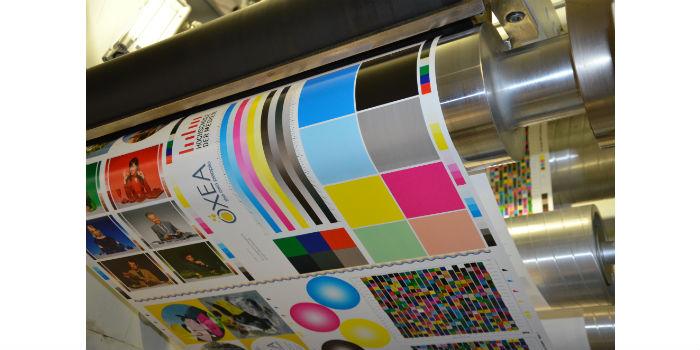
 United States. A more sustainable and economical printing is easily possible simply by replacing the solvent system. This is shown in a recent study. It was held at the Hochschule der Medien (HdM), Stuttgart, Germany, in professor Armin Weichmann's Rotogravure working group at the Faculty of Printing and Media and at the DFTA Flexographic Printing Competence Centre.
The scientists replaced conventional ethanol/ethyl acetate (Ethyls) 1:1 blends with a mixture consisting of n-propanol/n-propyl acetate (Propyls) and retained all other printing parameters. The study included industrial-scale tests under laboratory conditions with an execution length of 17,000 m in flexographic printing and an execution length of 10,000 m in gravure printing.
The result: Propyls-based printing processes offer decisive advantages over conventional Ethyls. The potential for savings of 30 percent on average in solvent consumption and 20 percent on average in the consumption of printing inks, as shown in industrial studies conducted by the main customers of the chemical company Oxea, was verified in the Stuttgart tests. Other important advantages have also been reproduced, such as the reduction of residual solvent content, the reduction of foaming in ink in flexographic printing and the ability to dispense with retardants such as ethoxypropanol.
"The results of the HdM study validate all of our experiences to date: propylene outperform conventional solvents such as ethyl acetate and ethanol in gravure or flexography processes without the need for additional adjustments," said application engineer Dr. Jens Klabunde of Oxea.
In several international industrial studies, Oxea's global leader for the Propyls project, Lucia Paniagua, has accompanied the exchange of Ethyls for Propyls in converters and printing plants with production runs of up to 2,000 km: "In all cases, considerable savings were achieved in printing inks and solvents, mainly with higher print quality. Other advantages, such as greater overall process stability and higher throughput due to lower material loss and higher print speeds, are perfect arguments that will motivate printers to use Propyls instead," he said.
Propylaea reduces the so-called plugging (drying). As a medium evaporation solvent, they evaporate more slowly than Ethyls but ensure that the ink is reliably dried in the process. It means that less post-dosing is required in the printing process, resulting in generally lower emissions of harmful substances, the so-called VOCs (volatile organic compounds).
In a Propyls solvent system, the pigments in the printing ink can be distributed more evenly over the film during application due to the slightly slower drying process. This results in a higher ink density for the same amount of pigment. In this way, the same print quality can be achieved with a significantly lower pigment, which saves expensive ink stocks. In addition, the improved emptying and collection characteristics of both the engraving cylinder and the anilox ensure optimal transfer of the printing ink over the film.