
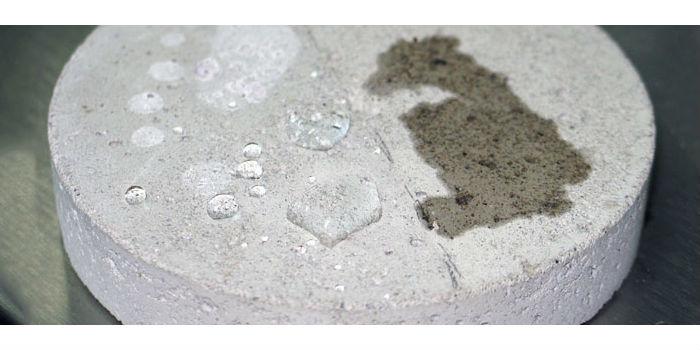
 Mexico. A research at the Autonomous University of Querétaro (UAQ) developed a nanocoating for surfaces that eliminates microorganisms found in the environment and repels water particles.
"The idea was to generate a coating that repelled water and that could be applied, in the first instance, to glass, thinking about problems such as dirt that adheres to building windows or car windshields, which in both cases can generate risks for people," said the researcher in the area of Nanotechnology of the Faculty of Engineering of the UAQ, Karen Esquivel Escalante.
He explained that this nanomaterial, for which patent registration has already been requested in terms of the synthesis method, is made of a combination of silicon oxide (SiO2) and titanium oxide (TiO2).
"There are materials similar to ours; however, the combination of them and how we get it is not on the market yet. This project is parallel to other research regarding self-cleaning coatings, with the difference that now it is migrated a little to the hydrophobicity part".
The hydrophobic and anti-pollution nanocoating project is a parallel line of research of self-cleaning paint based on nanostructured components and acting through solar energy, announced by this group of scientists from the Faculty of Engineering of the UAQ in 2016.
The student of the master's degree in sciences with terminal line in nanotechnology, Brenda Alicia Rosales Pérez, stressed that as part of the project the feasibility of this nanocoating is being applied on mortar and other structures of a stony nature is being studied.
"Many of the constructions use this compound and being in contact with the environment are exposed to pollutants, which is what we want to remedy, especially in historical constructions that require more care and of which it is not possible to modify their physical appearance or coloration."
Karen Esquivel explained that this coating, which is completely colorless, is placed as a varnish that when dried is adhered to the surface and does not allow the absorption of liquids or contaminants.
"This guarantees that there will be no damage to the surface, that the liquid will slip and will not adhere, much less generate stains or moisture transmission. Regarding pollutants, talking about nitrogen oxides (NOx), volatile organic compounds, sulfur oxides (SOx) or particles of organic matter, fecal and even viruses such as the flu that are dispersed in the environment; Titanium oxide has the property that these compounds destroy them producing carbon dioxide (CO2) and water. You could say that we are generating this gas, but in the end, the pollutant load is reduced from the point of view of toxicity, which is more friendly to the trees and plants that are the ones that finish the remediation process."
Currently, the laboratory work in this project focuses on performing tests of efficiency, humidity, ultraviolet radiation and winds controlled through an outdoor chamber to determine the durability and hardness of the coating.
Source: Conacyt.