
 International. An innovative measurement and evaluation process developed by Fraunhofer IPA (Fraunhofer Institute for Manufacturing and Automation Engineering) means that, for the first time, the properties of any paint can be used to predict its leveling behavior. By using this procedure when developing a painting, the development time can be reduced by 15% on average and 150,000 euros in development costs can be saved.
The undulation of a coated film represents an important criterion in the visual evaluation of the quality of the coating. Improper leveling can lead to a wavy surface that shows an "orange peel" appearance after drying. According to figures from the German Association of Paint and Ink Industries, annual sales of high-quality paints on the market amount to approximately 1.5 billion euros in Germany alone.
Of all the characteristics of painting, rheological behavior has the greatest influence on the leveling process. Most industrial uses require the paint to be thin enough to be easy to apply, but thick enough so that the resulting layer does not drain from sloping surfaces. In order to achieve a balance between these opposite characteristics, most industrial paints have a very complex rheological behavior with viscoelastic properties sensitive to cutting and sensitive to time. The rheological properties of paint can change progressively during the flow process, from a thin, watery substance to a gel-like one. As the flowing coat of paint is able to "remember" the previous strong shear during application, the rheological properties change, gradually, not suddenly. We call these "memory fluids."
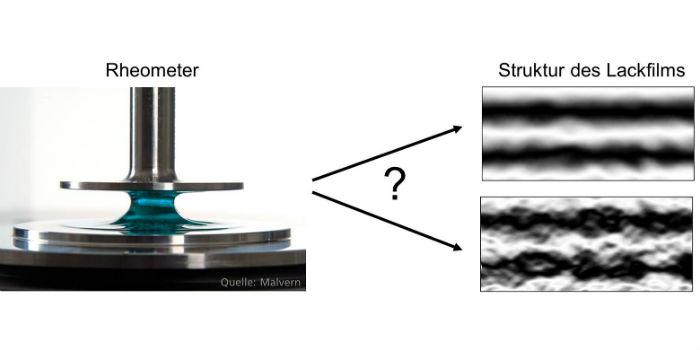
Industry-standard methods for measuring rheological behavior do not provide any data that can be used to judge in advance how painting will act with complex rheological behavior. The innovative measurement and evaluation process developed by Fraunhofer IPA means that, for the first time, the properties of any paint can be used to predict how fast and how completely it will level out. Rheological properties can be measured and translated into a leveling prediction.
The leveling process is of particular importance for paint manufacturers, who must optimize the rheological behavior of their paints during the development of the same. The new procedure accelerates paint development by reducing the need to test paint samples, and raw materials that will influence the leveling process can be applied in a more targeted way. While the general practice so far has been to test paint samples, with half a day of waiting before the paint manufacturer can get a leveling result, this time can be shortened to just 15 minutes with the new procedure.
Developer Fabian Seeler explains: "Based on our own experience in developing paint recipes, we consider that the total development time of a painting can be shortened by 15%. For an average development time of three years, this means saving 5.4 months, which represents a time advantage that could mean a huge competitive advantage when new colors are introduced for the car, for example. "According to an example calculation by Fraunhofer IPA, average costs of EUR 150 000 per paint development could be saved by reducing the need to paint test samples. Fraunhofer IPA will initially offer a paint characterization using the new procedure as a service. In the second phase, the plan is to also distribute the measurement and evaluation software directly to customers.
Source: Fraunhofer IPA.