
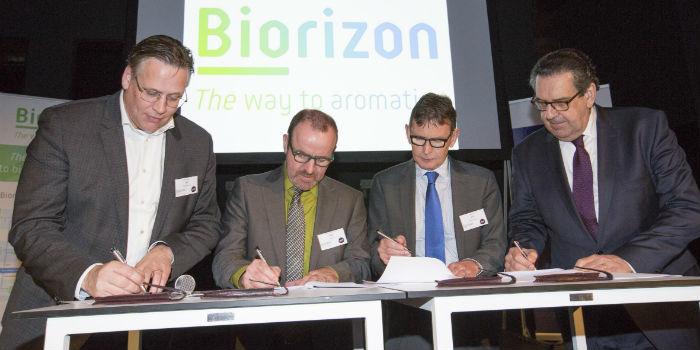
 International. The province of Noord-Brabant in the Netherlands, TNO (Netherlands Applied Scientific Research Organisation), ECN (Netherlands Energy Research Centre) and Flemish Vito are jointly investing €10 million in the development of bioaromatics, sustainable raw materials for the chemical industry.
Shared Research Center Biorizon will use the funds to fund several projects designed to achieve the goal of enabling commercial production of bioaromatics for the industry by 2025. The four parties made this announcement in Antwerp, Belgium, during Biorizon's annual event.
Biorizon plans to use the funding to accelerate the development of bioaromatics. Together with industry, it is developing technologies to extract aromatics from plant waste and other streams. In this way, it hopes to offer the chemical and supply sector a cost-effective and sustainable alternative for the extraction of raw materials from oil. The sustainable alternative has the possibility of replacing 40% of all chemicals.
During the event, Bert Pauli, Deputy Governor for Economic Affairs and Internationalization of the province of Noord-Brabant, called on the industry to more open innovation: "The province plans to use the investment to stimulate the sector to share more knowledge and involve the SME sector in research and development. In this way, we are firmly anchoring the bio-based sector in Brabant and connecting the Green Chemistry Campus, where Biorizon is located, Nieuw Prinsenland and the port and industrial area of Moerdijk. This boosts employment in the region and, in the long term, the competitive strength of the industry throughout the Netherlands."
The province of Noord-Brabant is investing five million euros until 2020 and TNO, ECN and VITO are investing another five million in total. This investment is intended to act as a flyer to connect companies and other stakeholders for many years to come with one or more of Biorizon's lines of research. These include the thermochemical conversion of biomass into aromatic compounds (led by ECN), from sugars to aromatic compounds (led by TNO), and from lignin to aromatic compounds (led by VITO).
The revenue received from the companies' participation will be invested in part by Biorizon in the research program, building the ecosystem in a future-proof way.
More than 200 companies are currently members of the Biorizon Community, several dozen of which are involved in projects, to which they also contribute financially. An example is the Waste2Aromatics project. Here, valuable raw materials for the chemical industry are produced from waste such as GFT, diapers, sieved material and manure.
Source: www.biorizon.eu