
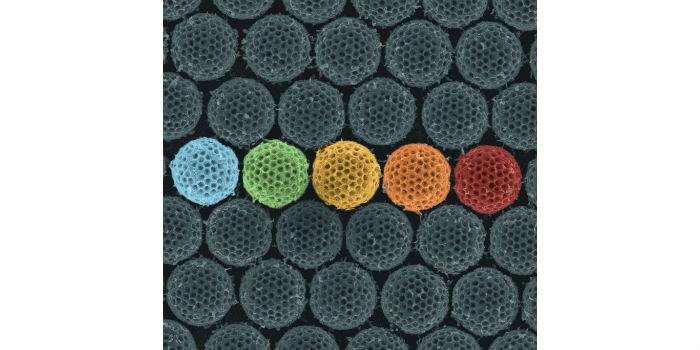
 United States. Synthetic microspheres with nanoscale holes can absorb light from all directions in a wide range of frequencies, making them candidates for anti-reflective coatings, according to a team of Penn State engineers.
Leaf hoppers extrude microparticles, called brochosomes, and clean them on their wings. Because the particles are superhydrophobic, the hopper wings are kept dry in wet conditions. What was not understood before the current work is that brochosomes also allow leafhoppers and their eggs to mix with their backgrounds at the wavelengths of light visible to their top predators, such as the ladybug beetle.
"We knew our synthetic particles could be optically interesting because of their structure," said Tak-Sing Wong, an assistant professor of mechanical engineering and an early career engineering professor in the Wormely family. "We didn't know, until my former postdoc and lead author of the study Shikuan Yang raised it at a group meeting, that the leaf hopper made these non-sticky coatings with a natural structure very similar to our synthetics, we wondered how the leaf hopper used these particles in nature."
Doing a search of the scientific literature revealed nothing about leaf hopper brochosomes used as camouflage. But the sizes of the pits in synthetic microspheres are very similar to the wavelength of light, and can capture up to 99 percent of light, from ultraviolet to visible to near-infrared. The surface of the particle acts as a metamaterial, the type of material used in camouflage devices.
The researchers simulated the insects' vision and found that brochosomes are likely camouflage coatings against leaf predators. Camouflage is common in nature, but there are very few examples of natural anti-reflective coatings, moth eyes are a prominent exception. Moth eyes are covered with anti-reflective nanostructures that prevent light from reflecting off them at night when predators can see them.
Synthetic microspheres are produced through a rather complex five-step process using electrochemical deposition. However, the process can be extended and many different materials can be used to make synthetic brochosomes, such as gold, silver, manganese oxide or even a conductive polymer.
Source: Penn State.