
 International. The research team led by Professor Insung Choi of the Department of Chemistry at Kaist University (Korea) developed a sprayable nanovoltage technique using plant-derived polyphenol that can be applied to any surface.
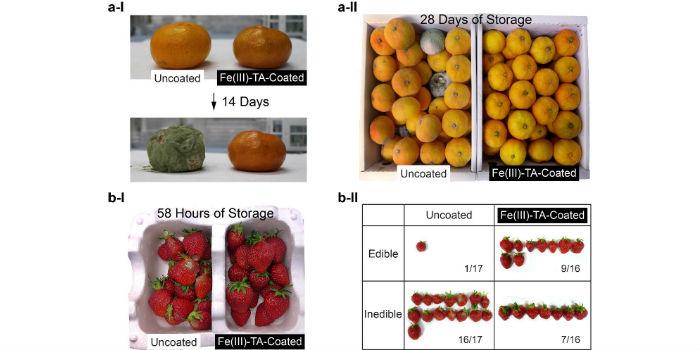
This new nanolayer process can be completed in seconds to form nanometer-thick films, allowing the coating of commodities, such as shoe and fruit insoles, in a controlled manner. For example, mandarin oranges and spray-coated strawberries show a significantly long post-harvest storage life, suggesting practical potential in edible coatings of perishable products.
The technology has been patented and is currently being marketed for widespread use as a means of preserving products. The results of the research have recently been published in Scientific Reports.
Polyphenols, a metabolite of photosynthesis, possess several hydroxyl groups and are found in a large number of plants that show excellent antioxidant properties. They have been widely used as non-toxic food additives and are known to exhibit antibacterial properties as well as potential anti-carcinogenic capabilities. Polyphenols can also be used with iron ions, which are found naturally in the body, to form an adhesive complex, which has been used in leather tanning, ink, etc.
The research team combined these chemical properties of polyphenol-iron complexes with spraying techniques to develop their nanocoating technology. Compared to conventional immersion coating methods, which immerse substrates in specialized coating solutions, this spraying technique can coat selected areas more quickly. The aerosol also prevents cross-contamination, which is a major concern for immersion methods. The research team has demonstrated the aerosol's ability to coat a variety of different materials, including metals, plastics, glass, as well as textile fabrics. The polyphenol complex has been used to form anti-fogging films on corrective lenses, as well as antifungal treatments for shoe soles, demonstrating the versatility of its technique.
In addition, spraying has been used to coat the product with a naturally antibacterial edible film. The coatings significantly improved the shelf life of mandarins and strawberries, retaining freshness beyond 28 days and 58 hours, respectively. (The uncovered fruit decomposes and gets wet under the same conditions.) See initial image.
Source: Kaist.