
 International. New materials have been developed by scientists at Swansea University's Energy Security Research Institute (ESRI), which are non-toxic, inexpensive and promise to replace more expensive and dangerous materials used for waterproofing and antifouling/fogging.
A new class of nanomaterials with tunable wettability has important applications ranging from antifouling to waterproofing surfaces. The materials made by scientists at Swansea University are inexpensive, non-toxic and can be applied to a variety of surfaces by spraying or coating by centrifuge.
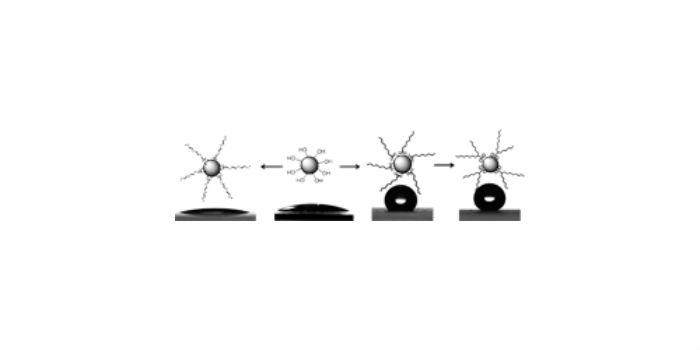
Spray-coated nanomaterials provide a texture to surfaces, regardless of substrate, and chemical functionality that can alter the surface, from superhydrophilic (wetting water) to superhydrophobic (water repellent) based on the choice of tailored functionality.
Wafaa Al-Shatty, a master's student at the Energy Security Research Institute on Swansea University's Campus, carried out low surface energy manufacturing and testing of high surface energy materials.
There, he synthesized aluminum oxide nanoparticles using linear hydrocarbons and branched carboxylic acids (with different surface energies) to demonstrate that hydrophobicity can be easily adjusted based on the nature of chemical functionality. Research shows that subtle changes in the organic chain allow control of surface wettability, roughness, surface energy, and the ability of nanoparticles to behave like surfactants.
Both hydrophobicity and hydrophilia are reinforced by roughness. Nanoparticles with methoxy (-OCH3) functionality exhibit high surface energy and therefore superhydrophilicity properties. On the other hand, branched hydrocarbons reduce surface energy. Spiked (branched) chains are the first line of defense against water along with surface roughness (caused by nanoparticles in both cases). This minimizes contact between the surface and water droplets, allowing them to slide.
To be superhydrophobic, a material has to have a water contact angle greater than 150 degrees, while superhydrophilic surfaces are materials whose surfaces exhibit water contact angles less than 10 degrees. The contact angle is the angle at which the surface of the water meets the surface of the material.
Hydrocarbon-based superhydrophobic material can be a "green" substitute for expensive and dangerous fluorocarbons commonly used for superhydrophobic applications. "They are also able to reduce the interfacial stress of various oil-water emulsions by acting as surfactants," Alexander said.
Understanding the relationships between superhydrophobic and superhydrophilic nanoparticles and the resulting oil stability, emulsion properties, and interfacial stress at the oil/water boundary is very instructive, providing insights that could greatly benefit the future development of greater efficiency in oil recovery by Oil Recovery (EOR).
Source: Swansea University.