
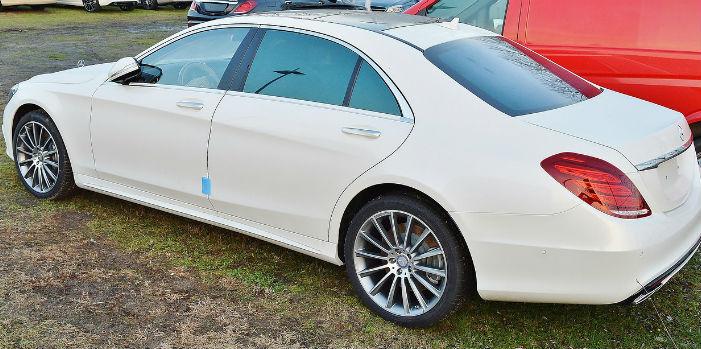
 International. In Asia they developed a new hard coating technology that can be applied uniformly on large or complex car windows made of resin to achieve the same level of abrasion resistance as glass windows and twice the weather resistance of conventional plastic glass.
To further reduce the weight of cars, automakers are looking to use lightweight, but highly abrasion-resistant side and back windows made of resin. Conventional polycarbonate (PC) plastic glass, which is less resistant to abrasion than glass, can be scratched even by lifting or lowering them or running the windshield wipers.
According to Japanese car safety standards, the plastic glasses of car models released from July 2017 must offer increased abrasion resistance. However, the conventional wet method used for hard coating does not meet the required level of strength. In addition, plastic windows in new cars will be required to be weatherproof enough to prevent yellowing after prolonged exposure to sunlight.
Although there is a technology to add a layer of enhanced plasma chemical vapor (CVD) deposition to improve the abrasion and weather resistance of the wet-coated PC at the glass level, the window size is limited to approximately 0.3 square meters. It is also difficult to apply plasma CVD to complex curved surfaces. Therefore, this technology does not offer a practical solution for plastic crystals under the new automotive standards.
In response, the Japanese company Teijin, creator of the development, collaborated with Tsukishima Kikai Co., Ltd. to develop a plasma CVD pilot plant that is capable of treating large, three-dimensional molded resin products with a uniform plasma CVD coating. The pilot plant is treating plastic glass of real dimensions greater than one m2, including those with complex curves for rear windows.
The new hard coating technology firmly applies a CVD layer of plasma to the wet hard coating layer, thus preventing oxygen or water vapor from penetrating and subsequently degrading the underlying wet hard layer. Since the wet hard layer absorbs the ultraviolet rays that cause the degradation of the resin, the duration until the discoloration or degradation is lengthened to twice as much as only the wet hard layer by combination with the CVD method.
Source: Teijin.