
International.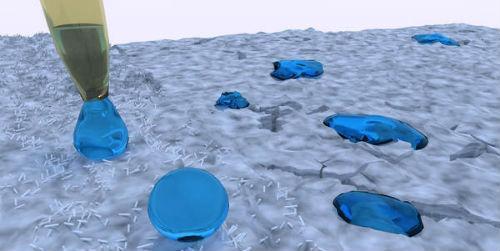 A team of scientists has found an unusual way to protect the mortar from moisture. When the material is mixed, they add a biofilm. Moisture can destroy a mortar over time – for example, when cracks form as a result of frost.
During a conversation with a colleague at TUM, Professor Oliver Lielegusually, from the Technical University of Munich, came up with the idea of using biofilms to alter the properties of building materials. Professor Christian Große, did the chair of Non-Destructive Testing. Among other things, he investigated self-healing concrete whose cracks close autonomously. A variant of this concrete contains added bacteria. Activated by the entry of moisture, bacteria close the cracks with metabolic products containing calcium.
The key ingredient in the new material is the biofilm produced by the bacterium Bacillus subtilis. "Bacillus subtilis normally lives in soil and is a very common microorganism," explains Oliver Lieleg. "For our experiments, we used a simple laboratory strain that grows rapidly, forms a lot of biomass and is totally harmless." Lieleg's team bred the bacterial film in a standard culture medium in the lab. They then added the wet biofilm to the mortar powder.
An explanation for the water-repellent properties of the hybrid mortar can be found in electron microscope images: The surface is covered with small crystalline peaks. This results in what is known as the lotus effect, which also occurs on the leaves of the lotus plant. Small uniform structures on the surface ensure that only a small part of a drop of water is actually in contact with the leaf surface. The surface tension of the drop is stronger than the forces that cause it to adhere to the leaf. Consequently, the drop easily rolls off the blade when the blade is tilted.
Data Source Provider: Technical University of Munich.