
International. 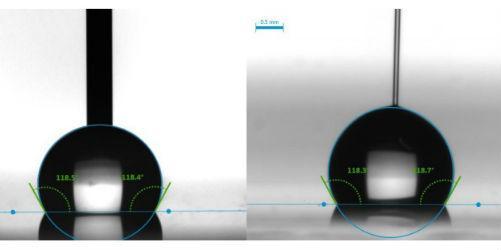 Using the Liquid Needle dosing technique, Krüss GmbH revealed that it is recently using a new droplet positioning method to measure the static contact angle.
The pressure-based method significantly speeds up the dosing process compared to classical needle dosing. Here, the dosed units arranged in parallel produce two droplets at the same time allowing measurements of the energy-free surface to be carried out within a second. A current scientific study in the journal Colloid and Polymer Science verifies that contact angles are measured accurately, despite this high speed.
During the study, contact angles were measured in 14 different materials with the new pressure dosing method and the classic needle dosing technique. With a wide range of hydrophobic and hydrophilic surfaces, rough and smooth, as well as chemically pure and technical, the research covers all practical cases. The results show, without exception, a good agreement between the contact angle results of the two dosing methods.
Alternatives to needle dosing have previously failed due to the region outside the contact zone of the drop being pre-moistened while the dynamics were too high. This falsifies the contact angle resulting in values that were too small. On the contrary, with the KRÜSS method, droplets are formed in a controlled manner and with low dynamics with the help of a continuous jet. The jet is so thin compared to the size of the final droplet that the contact area does not propagate to a greater extent than with needle dosing.