
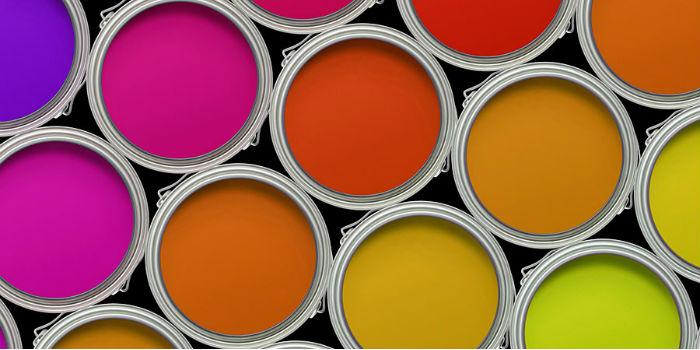
 The manufacture of this kind of paints requires correctly implementing its different stages. The author describes and explains them in detail.
by José Tomás Rojas*
In a past column we have described what are the components that make up a formula of paints, and what is the function of each of them. Of course, these elements are not painting in themselves. It is necessary to combine them in appropriate proportions, resulting in a functional coating.
This combination is what is known as a formula or recipe, and in general it is technology that is accessible to the interested public. Painting recipes can be obtained after a quick search on the internet, and even suppliers of raw materials give initial formulas as a reference, but equally, having a recipe does not imply making a paint. It is necessary to follow a systematic process of combination and conditioning that allows to convert into a painting the materials indicated in the formula. Now, we will go on to review what are the stages necessary to achieve the precise combination of these components, so that a functional coating can be produced.
Dispersion stage
Dispersion is the most important stage in the development of an emulsified paint. As the name implies, it consists of reducing, by means of mechanical elements, the particle size of the pigments and charges present in the formulation. This is of great importance, since most of the properties of the paint will depend on this process being carried out correctly.
It must be taken into account that one of the important characteristics of this step is that we must combine and stabilize materials that are incompatible with each other, in this case: water, latex, pigments and additives of different chemical nature. To understand how we achieve this purpose, it is necessary to know what are the steps that make up the dispersion process (See Fig.1).
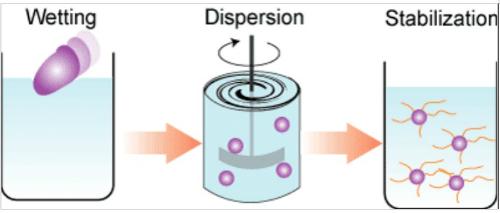
Fig. 1 Stages of the dispersion process. Wetting, Dispersion and Stabilization
Moistening
In the first stage, called wetting, the process water must be conditioned, lowering its surface tension, using additives known as humectants. This favors the compatibility of water with materials such as Titanium Dioxide and Calcium Carbonate, which are part of the formulation process. Dispersants are also added, which will allow, once the pigments are dispersed, to stabilize them, which implies preventing their reglomeration. Moisturizers and dispersants are the key additives of this phase. In general, these are non-ionic surfactants and sodium polyacrylates.
As high-speed rotating mechanical elements are employed, there is a good chance that foam will form, so it becomes necessary to add anti-foaming additives to the process water. These materials are generally derived from mineral oils and silicone oils.
Depending also on the degree of hardness of the water (presence of Calcium and Magnesium salts), it is recommended to add additives that sequester the ions free of Ca++, and Magnesium++, since their presence blocks the effectiveness of moisturizing and dispersing additives. Finally, an additive for pH adjustment should be added, since emulsified paints usually work in alkaline medium.
Dispersion / stabilization
Once the process water is prepared, the next stage consists of the addition, dispersion and stabilization of the pigments and fillers. Normally, these materials represent a significant amount within the formulation, and it is recommended to add them to the process water, by gentle mixing at the beginning, and after they have all been incorporated, the speed is increased.
For this purpose, Rotary axis equipment is generally used, with a toothed disc as a dispersion element. Usually these equipment have variable speed drives, which allow working in low and high regimes.
It is key that the viscosity of this mixture or dispersion "Paste" is appropriate, and should be around 70 Ku. If the viscosity is adequate, the dispersion paste in motion inside the container containing it will take on a form known as a dispersion "donut", indicating that the process is carried out normally. (See Fig. 2).
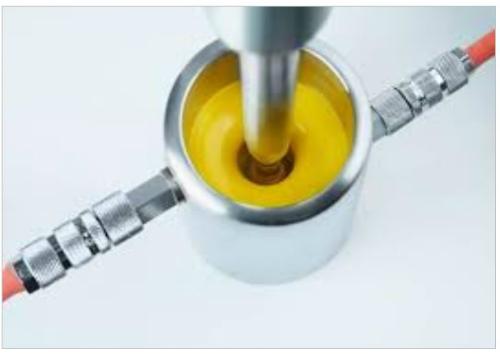
Fig 2. Dispersion "dona".
If the process is done correctly, the total dispersion of pigments and fillers takes about half an hour. There are equipment to measure dispersion. The most common is the Hegman bar, which allows to determine the size reached by the pigments and loads, on a scale ranging from 1 to 7, being 1H poor or no dispersion, and 7H, maximum dispersion. The Hegman Value, for matt emulsified paints is around 5H.
Stage of completion or "Let Down"
Once the dispersion paste is ready, the final stabilization and addition of the rest of the materials of the formula is carried out. In a normal process it is customary to place the dispersion tank on a platform, and on the ground floor a tank containing latex and other additives such as biocides, thickeners, and some more defoamer is placed. Already with all the components in this tank, the paste is dropped into it (Let Down), and with soft mixing the incorporation of all the components is achieved. See fig 3.
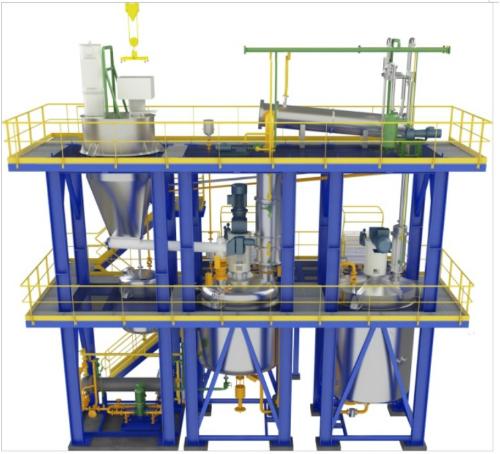
Fig 3. Dispersion tanks (platform) and completed (Let Down).
The key additives in this phase are thickeners, and their form of aggregate will depend on their nature, whether they are cellulosic or associative. Cellulosics are usually derived from Hydroxy Ethyl Cellulose (HEC), and Associatives are, among others, derivatives of sodium polyacrylate, but with longer molecular chains than those to which dispersants belong.
Color and viscosity adjustment
Already in this last stage, the necessary coloring pastes are added to achieve the color that the paint will have, and the viscosity is adjusted with water. The pH is adjusted by appropriate additives, according to the parameters indicated in the formula, and at this moment we already have a functional paint, ready to be packaged and marketed.
I take this opportunity to communicate to my readers that I am now based in Lima, Peru. From here I will continue to contribute with the small contribution that my column can make to the development of paint technology.
* José Tomás Rojas. TROJAS Pinturas, F.P. You can send your comments to the email [email protected] (Tel: +51 963 052 056), Twitter: @JtrojasPinturas.