
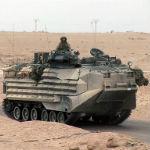
 United States. The U.S. Naval Research Laboratory (NRL) has found that some types of rubbers provide corrosion protection – and potentially better ballistic protection – for amphibious assault vehicles (AAVs).
This is important for the United States Marine Corps (USMC), as they seek to expand the AAVs, introduced in 1972, until 2035. "Innovative sustainable concepts, such as those the NRL is investigating, will allow us to avoid the cost of new design, development, and production of new components," said Tim Bergland of the USMC Office of Advanced Amphibious Assault (AAA).
NRL showed that certain types of rubber, called polyureas, could better protect armor from corrosion by stretching with it, rather than cracking like brittle paint. They also showed that polyurea coatings slow down slows and fragments. "They take the kinetic energy from the bullet," Roland says. "So the bullet, in order to stay penetrating, encounters an increasingly resistant medium. And if it slows down enough it will always hit the steel plate, but it doesn't have enough speed to get through it."
By exposing the saltwater steel specimens in their lab, Roland and Gamache also showed that polyurea protects armor from corrosion much better than paint.
"Paintings tend to crack," says Dr. Mike Roland, who led the project. "Polyureas don't do it because they're elastomers, rubbers." "We wanted to simulate what's happening on the field, so we tilted some of the test pieces," Roland says. In addition to the flat specimens, "we had a smooth curve and had a sharp curve of 90°." They tested five coatings: two types of paint, one NRL polyurea used in other shielding applications, and two polyurea developed by a private company.
"We have created tanks full of seawater. We've set the temperature at 40 and 50 Celsius, just to speed up corrosion, and it makes us bubble air, so there was a lot of oxygen." Polyurea worked much better than paint. "If you just put the plate flat, they go to all the work," Roland says. But with folded pieces, "paints tend to crack Polyureas don't because they are elastomers, rubber; So they stretch and don't open a path for water."
Image: Wikipedia.