
 International. Bayer MaterialScience has developed a new technology for the low-temperature coating of plastic parts in automobiles. The fenders, mirror housings, ailerons, rear doors and roof modules are finished with their external transparent layer at a cost- and energy-efficient temperature of only 80°C.
Although curing is as much as 30% faster than with the proven two-component polyurethane coatings, the appearance is very good. In the medium term, this technology will offer the possibility of coating together plastics, composites and metal parts of cars for the first time.
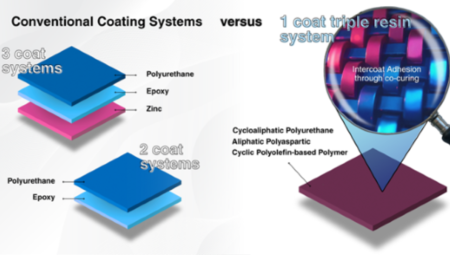
The transparent layer is responsible for the external appearance. This is the last layer to be applied to the body, and gives the vehicle its high-gloss finish. Two-component coatings formulated with polyurethane (PUR) raw materials from Bayer MaterialScience have proven invaluable for this. Along with their exceptional appearance, they also boast excellent resistance to weathering, chemicals and impact.
The company explained that the heart of the new technology is a thermolating hardener that makes it possible to separate film formation and curing. "The coating initially flows smoothly over the substrate and forms a uniform film. Only when the temperature rises is the hardener present in the coating activated by a special latent catalyst. This ensures that the coating dries quickly onto the plastic substrate."
This technology does not require major changes in coating formulation. Therefore, two-component PU thermolatent systems can be used to coat plastic added in series production without any problems. Even in cases where faster drying is not an advantage, the new development still allows the pieces to proceed more easily and quickly after cooking.