
 United States. Water-resistant fabrics are essential for everything from waterproof clothing to military tents, but conventional water-repellent coatings have been shown to persist in the environment and accumulate in our bodies, so they are likely to be removed for safety reasons. That leaves a big gap to be filled if researchers can find safe substitutes.
Now, an MIT team has come up with a promising solution: a non-toxic coating that not only adds water repellency to natural fabrics like cotton and silk, but is also more effective than existing coatings. The new findings are described in the journal Advanced Functional Materials, in a paper by MIT professors Kripa Varanasi and Karen Gleason, former MIT postdoctoral fellow Dan Soto, and two others.
"The challenge has been driven by environmental regulators" due to the phasing out of existing waterproofing chemicals, Varanasi explains. But it turns out that your team's alternative actually outperforms conventional materials.
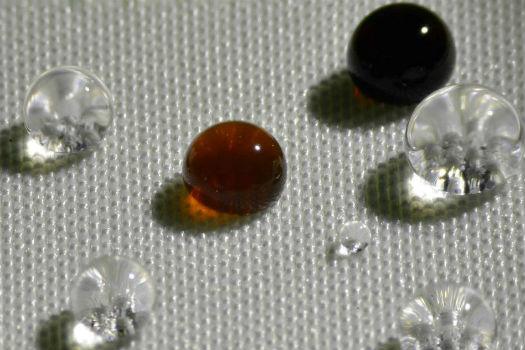
"Most fabrics that say 'water repellent' are actually water resistant," says Varanasi, an associate professor of mechanical engineering. "If you stand in the rain, eventually the water will pass." In short, "the goal is to be repellent, to bounce the drops." The new coating is closer to that goal, he says.
Because of the way they accumulate in the environment and body tissue, epa is in the process of revising regulations on long-chain polymers that have been the industry standard for decades. "They're everywhere, and they don't degrade easily," Varanasi says.
Research has shown that polymers with fewer than eight perfluorinated carbon groups do not persist and bioaccumulate almost as much as those with eight or more, the most commonly used. The MIT team combined two things:
- A shorter-chain polymer that, by itself, confers some hydrophobic properties and has been enhanced with some additional chemical processing
- A different coating process, called initiated chemical vapor deposition (iCVD)
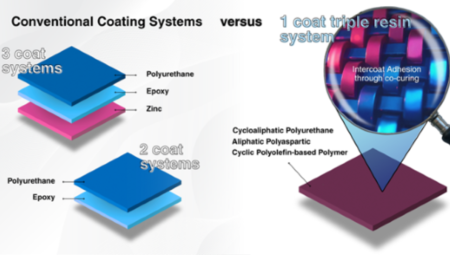
The use of the iCVD coating process, which does not involve any liquid and can be performed at low temperature, produces a very thin and uniform coating that follows the contours of the fibers and does not clog the pores, thus eliminating the need for the second stage of processing to reopen the pores.
Then, an additional step, a sandblasting on the surface, can be added as an optional process to further increase water repellency. "The biggest challenge was finding the sweet spot where performance, durability and iCVD compatibility could work together and deliver the best performance," says Soto.
The process works on many different types of fabrics, Varanasi says, including cotton, nylon and linen, and even on non-textile materials such as paper, opening up a variety of possible applications. The system has been tested on different types of fabric, as well as on different weaving patterns of those fabrics. "Many fabrics can benefit from this technology," he says. "There's a lot of potential here."
Source: MIT.