
 United States. Researchers have found a way to turn microscopic nanoparticle-coated beads into lasers smaller than red blood cells.
These microlasers, which convert infrared light into light at higher frequencies, are among the smallest continuous emission lasers ever recorded and can constantly and stably emit light for hours, even when immersed in biological fluids such as blood serum.
The innovation, discovered by an international team of scientists at the U.S. Department of Energy's Lawrence Berkeley Lab, opens up the possibility of imaging or controlling biological activity with infrared light and for the manufacture of light-based computer chips.
The unique properties of these lasers, which measure 5 microns (millionths of a meter), were discovered by accident as researchers were studying the potential of polymer (plastic) beads, composed of a translucent substance known as colloid, to be used in brain imaging.
Angel Fernandez-Bravo, a postdoctoral researcher at the Berkeley Lab Molecular Foundation, lead author of the study, mixed the beads with "doped," or embedded, yttrium and sodium fluoride nanoparticles with thulium, an element belonging to a group of metals known as lanthanides. The Molecular Foundry is a nanoscience research center open to researchers from all over the world.
The periodic peaks chan and Levy had observed are a light-based analog so-called "whisper gallery" acoustics that can cause sound waves to bounce along the walls of a circular room so that even a whisper is heard on the opposite side of the room.
This whispering gallery effect was observed in the dome of St Paul's Cathedral in London in the late nineteenth century, for example.
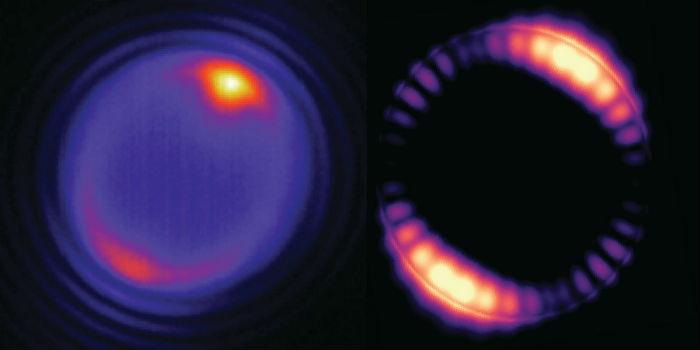
In the latest study, Fernández-Bravo and Schuck found that when an infrared laser excites the tullium-doped nanoparticles along the outer surface of the pearls, the light emitted by the nanoparticles can bounce around the inner surface of the pearl just like the whispers bouncing off the walls of the cathedral.
Light can make thousands of trips around the circumference of the microsphere in a fraction of a second, causing some frequencies of light to interact (or "interfere") with themselves to produce brighter light, while other frequencies cancel out. This process explains the unusual peaks that Chan and Levy observed.
When the intensity of the light traveling around these pearls reaches a certain threshold, the light can stimulate the emission of more light with the exact same color, and that light, in turn, can further stimulate the light. This amplification of light, the basis of all lasers, produces intense light over a very narrow range of wavelengths in the beads.
Source: Berkeley Lab.