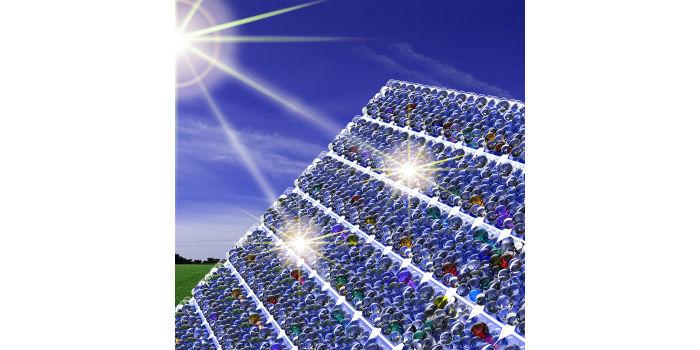
 United States. Researchers at the National Institute of Standards and Technology (NIST) have developed a nanoscale coating for solar cells that allows them to absorb about 20 percent more sunlight than uncoated devices.
The coating, applied with a technique that could be incorporated into manufacturing, opens a new path to develop low-cost, high-efficiency solar cells with abundant, renewable and eco-friendly materials.
The coating consists of thousands of tiny glass beads, only about a hundredth the width of a human hair. When sunlight hits the coating, light waves are directed around the sphere at the nanoscale, similar to the way sound waves travel around a curved wall, such as the dome of St. Paul's Cathedral in London. In those curved structures, known as acoustic murmur galleries, a person standing near one part of the wall easily hears a faint sound originating from anywhere else on the wall.
Whispering galleries of light were developed about a decade ago, but researchers have recently explored their use in solar cell coatings. In the experimental assembly devised by a team that includes NIST's Dongheon Ha and the University of Maryland's NanoCenter, the light captured by the nanoresonator coating is eventually filtered out and absorbed by an underlying solar cell made of gallium arsenide.
Using a laser as a light source to excite individual nanoresonators in the coating, the team found that coated solar cells absorbed, on average, 20 percent more visible light than bare cells. The measurements also revealed that the coated cells produced about 20 percent more current.
The study is the first to demonstrate the efficacy of coatings using precision nanoscale measurements, Ha said. "Although calculations have suggested that coatings would improve solar cells, we couldn't prove this was the case until we've developed the nanoscale measurement technologies that were needed," he said.
The team also devised a quick and less expensive method for applying the nanoresonator coating. The researchers had previously coated semiconductor material by immersing it in a bathtub of the nanoresonator solution. The immersion method takes time and coats both sides of the semiconductor, although only one side requires treatment.
In the team's method, droplets from the nanoresonator solution are placed on only one side of the solar cell. A wire-wound metal bar is then pulled through the cell, spreading the solution and forming a coating made of tightly packed nanoresonators. This is the first time researchers have applied the rod method, used for more than a century to coat the material in a factory setting, to a gallium arsenide solar cell.
Source: National Institute of Standards and Technology (NIST).