
 International. A team of chemistry researchers from the University of Sydney's Nano Institute has developed nanostructured surface coatings that have antifouling properties without using any toxic components.
Biofouling – the accumulation of harmful biological material – is a major economic problem, costing aquaculture and shipping industries billions of dollars a year in maintenance and use of additional fuel. Increased trawling on ship hulls due to biofouling is estimated to cost Australia's shipping industry $320 million a year.
Since the ban on the toxic antifouling agent tributyltin, the need for new non-toxic methods to stop marine biofouling has been pressing.
Research team leader Associate Professor Chiara Neto said: "We are eager to understand how these surfaces work and also push the boundaries of their application, especially for energy efficiency. Slippery coatings are expected to reduce drag resistance, meaning objects, such as ships, could move through water with much less energy required."
The new materials were tested linked to shark nets in Sydney's Watson Bay, showing that the nanomaterials were efficient at resisting biofouling in a marine environment.
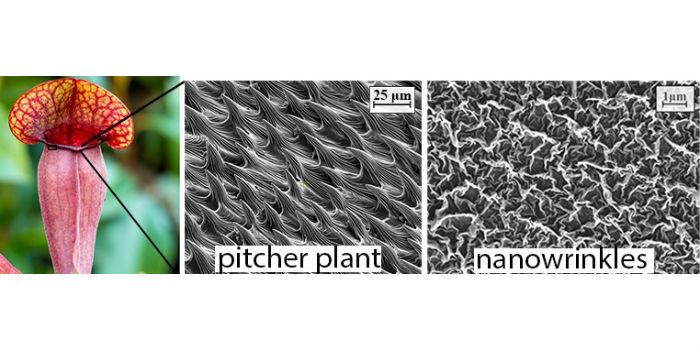
The new coating uses 'nanowrinkles' inspired by the carnivorous plant Nepenthes jarro. The plant traps a layer of water in the small structures around the edge of its opening. This creates a slippery layer that causes insects to move on the water plane on the surface, before they fall into the pitcher where they are digested.
The nanostructures use materials designed at the scale of billionths of a meter, 100,000 times smaller than the width of a human hair. Neto Group Associate Professor at Sydney Nano is developing nanoscale materials for future development in the industry.
the slippery surface developed by Neto stops the initial adhesion of bacteria, which inhibits the formation of a biofilm from which marine organisms can grow that dirty the organism.
In the lab, slippery surfaces withstood almost all the fouling of a common species of marine bacteria, while Teflon control samples without the lubricating layer became completely dirty. Not satisfied with testing surfaces under highly controlled laboratory conditions with a single type of bacteria, the team also tested surfaces in the ocean, with the help of marine biologist Professor Ross Coleman.
Test surfaces were connected to swimming nets at Watsons Bay Baths in Sydney Harbour over a seven-week period. In the much harsher marine environment, slippery surfaces were still very efficient at resisting fouling.
Antifouling coatings are moldable and transparent, making their application ideal for underwater cameras and sensors.
Data Source Provider: University of Sydney.