
 United States. When joining two pieces of metal, the metals must melt a little where they are or some molten metal must be introduced between the pieces. But MIT researchers have found that, in some situations, fusion can inhibit the metal's bonding rather than promote it.
The finding could have serious implications for the design of certain coating processes or for three-dimensional printing, which require materials to adhere and remain so.
The research was carried out by postdocs Mostafa Hassani-Gangaraj and David Veysset and professors Keith Nelson and Christopher Schuh.
Schuh, professor of Metallurgy at Danae and Vasilis Salapatas and head of the Department of Materials Science and Engineering, explains that one of the papers describes "a revolutionary advance in technology" for observing very high-speed interactions, while the other makes use of that high-speed imaging to reveal that fusion induced by impacting metal particles can impede bonding.
The optical setup, with a high-speed camera that uses 16 separate charge device (CCD) image processing chips and can record images in just 3 nanoseconds, was primarily developed by Veysset. The camera is so fast that it can track individual particles spraying onto a surface at supersonic speeds, a feat that was not previously possible. The team used this camera, which can shoot up to 300 million frames per second, to observe a spray paint-like process similar to those used to apply a metal coating to surfaces in many industries.
While these processes are widely used, so far their characteristics have been determined empirically, as the process itself is so fast that "you can't see, you can't tell what's happening, and no one has been able to see the moment when a particle hits and sticks," Schuh says. As a result, there has been an ongoing controversy over whether metal particles actually melt when they hit the surface to be coated. The new technology means that now researchers "can observe what's happening, study it and do science," he says.
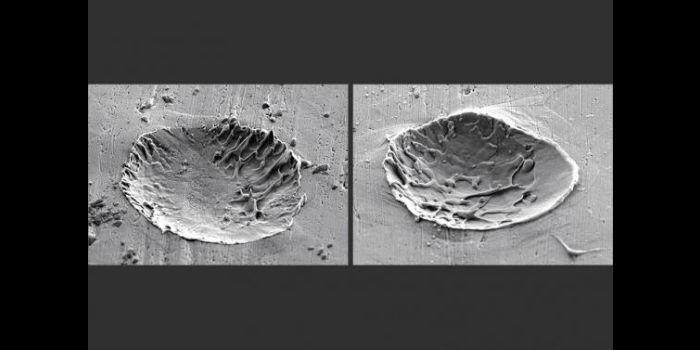
The new images make it clear that under certain conditions, metal particles that are sprayed on a surface actually melt the surface and that, unexpectedly, prevents them from sticking. The researchers found that the particles bounce off in much less time than it takes for the surface to resolidify, leaving the surface that is still molten.
If engineers find that a coating material is not bonding well, they may be inclined to increase the spray speed or temperature to increase the chances of melting. However, the new results show the opposite: fusion should be avoided.
It turns out that the best bonding occurs when the impacting particles and the impacted surfaces remain in a solid state but are "splashed" outward in a way that looks liquid. It was a "revealing observation," according to Schuh. That phenomenon "is found in a variety of these metal processing methods," he says. Now, it is clear that "to glue metal with metal, we have to make a splash without liquid. A solid splash sticks, and a liquid one does not. "With the new ability to observe the process, Hassani-Gangaraj says," with precise measurements, we could find the conditions necessary to induce that link."
The findings could be relevant to the processes used to coat engine components in order to reuse worn parts rather than relegating them to the scrap tray. "With an old engine of a big earthmoving machine, it costs a fortune to throw it away, and it costs a fortune to melt it and melt it down," Schuh says. "Instead, you can clean it and use a spraying process to renew the surface." But that requires the sprayed coating to remain securely adhered.
In addition to coatings, the new information could also help in the design of some metal-based additive manufacturing systems, known as three-dimensional printing. There, as with coatings, it is critical to ensure that one layer of the print material adheres solidly to the previous layer.
Source: MIT.