
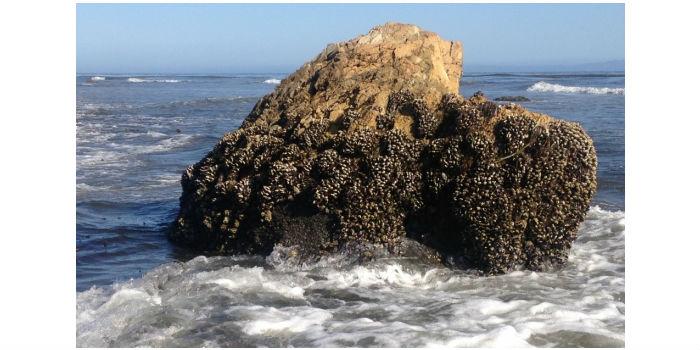
 United States. Inspired by the hard polymer bezel threads that marine mussels use to protect themselves in intertidal rugged areas, a team of researchers affiliated with the UC Santa Barbara Materials Research Laboratory (MRL) has developed a method to overcome the inherent trade-off between strength and flexibility in elastomeric polymers.
"Over the past decade, we've made tremendous strides in understanding how biological materials keep force under load," said corresponding author Megan Valentine, an associate professor in UCSB's Department of Mechanical Engineering.
"In this paper, we demonstrate our ability to use that understanding to develop useful artificial materials. This work opens up exciting avenues of discovery for many commercial and industrial applications."
UCSB researchers incorporated mussel-inspired iron coordination bonds into a dry polymeric system. This is important because such a dry polymer could be replaced by rigid but fragile materials, especially in applications related to impact and torsion.
To achieve networks that have architecture and performance similar to those of the mussel buffalo cuticle, the team synthesized an amorphous, poorly crisscrossed epoxy network and then treated it with iron to form dynamic iron-catechol cross-links. In the absence of iron, when one of the covalent cross-links is broken, it is broken forever, because there is no mechanism for self-healing.
But when reversible iron-catechol coordination bonds are present, any of those broken iron-containing cross-links can be reformed, not necessarily in the same place but nearby, thus maintaining the resilience of the material even as its strength increases. The material is both stiffer and more resilient than similar nets that lack iron-containing coordination links.
As the iron-catechol net is stretched, it does not store the energy, so that when the tension is released, the material does not bounce like a rubber, but dissipates the energy. The material is then slowly recovered to resume its original shape, in the same way that a memory foam-like material does after pressure is released on it.
Source: UC Santa Barbara.