
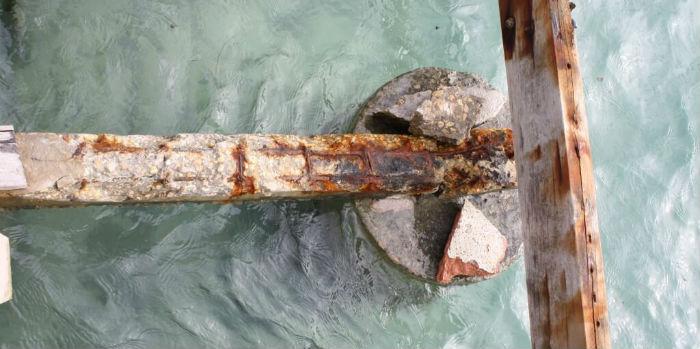
 International. Mixed cement is widely used in critical structures mainly due to its increased corrosion resistance. But how does the material behave in the marine environment? This has been investigated in a long-term study conducted by Indian researchers.
The paper presents the long-term corrosion performance of pozzolanic portland cement (PPC) and Portland cement with slag (PSC) under the three marine exposure conditions: the atmospheric zone (AZ), the immersion zone (IZ) and the splash zone. The Coastal Platform Marine Electrochemistry Centre (Opmec) in Tuticorin, India, was selected as the exhibition station.
The concrete cubes were exposed for 10 years and their physicochemical properties such as compressive strength, alkalinity, free chloride content and sulfate content, biofouling binding and electrochemical properties such as AC impedance and potentiodynamic polarization were carried out and the results obtained were compared with Ordinary Portland Cement (OPC).
It was observed that the strength and alkalinity of mixed cement concretes were relatively equal to those of OPC concrete. In addition, the pH values of mixed cement concretes are above the recommended threshold limit for depassivation. The penetration resistance of the chloride ion was significantly reduced for the mixed cement concretes and also exhibited a very high amount of bio-fouling fixation. Electrochemical studies revealed that mixed cement concretes have higher corrosion resistance in all three exposure zones. From the results it is observed that mixed cement concretes are highly recommended for aggressive marine environments instead of OPC concrete.
Source: http://www.sciencedirect.com