
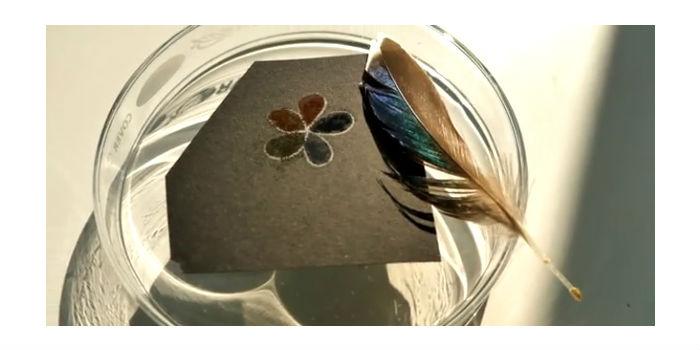
 United States. Scientists from the University of Akron, Northwestern University and Ghent University demonstrated a feasible solution for producing structural colors inspired by bird feathers.
Nature provides many spectacular examples of structural colors, such as duck wing feathers and wild turkey feathers. In continuing his previous research that unraveled the fundamental properties of melanin—a family of natural pigments found in the skin, hair, eyes, and plumage of brightly colored birds—these examples served as bio-inspiration for the design of core-shell synthetic melanin nanoparticles for the production of bright structural colors.
"Melanin is an important biomaterial that has so far been underutilized in materials science and technological applications," said Dr. Ali Dhinojwala, H.A. Morton Professor of Polymer Science and one of the principal investigators on the project.
In this most recent research, the team has discovered that tiny packages of synthetic melanin produce structural color when packaged in semi-ordered spherical particles. Structural color occurs through the interaction of light with materials that have patterns on a sub-micron scale, which reflect light to make some wavelengths brighter and others darker.
"The chemistry we use to make these particles is based on the main ingredient that goes into making melanin," says Dhinojwala. "So we take these melanin particles and self-assemble into a structure using a very straightforward process. It's similar to the things we see in our homes, like mixing oil and water together creating emulsions. Those emulsions essentially allow us to mount these particles into the photonic inks we call photonic supraballs.
These nanoparticles self-assembled using a single-vessel reverse emulsion process, adds Ming Xiao, currently a postdoctoral researcher. "It resulted in brilliant and not iridescent supraballs. With the combination of just two ingredients, synthetic melanin and silica, we can generate a full spectrum of colors."
"Using melanin as the core material can increase the brightness and saturation of supraballs due to their unique combination of high RI and broadband absorption of lights. In addition, melanin is biocompatible and can dissipate nearly 90% of UV radiation in heat within a nanosecond, making melanin-based supraballs suitable for cosmetics or UV-resistant inks."